
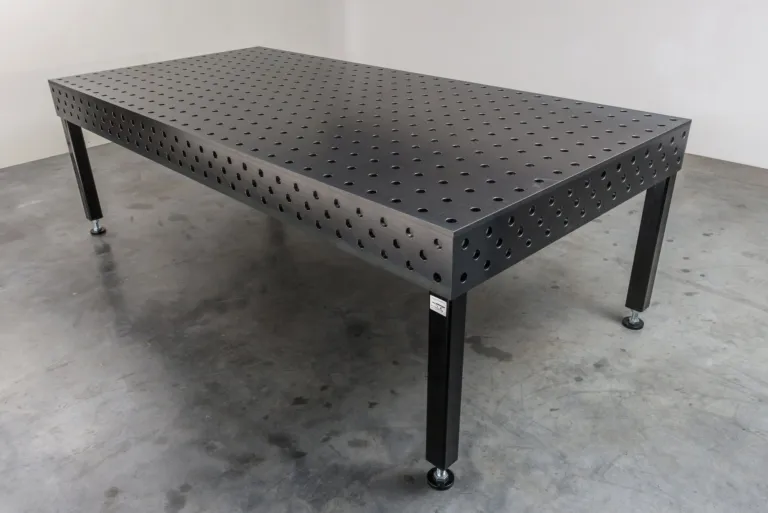
Large and custom sizes
If you need a large welding table, the largest series size from die schmiede is the PRO table …
Guide: size and weight
The right welding table size follows from your typical workpiece plus room for clamping tools, and the right plate thickness from component weight and clamping forces. Here you find formats, weights, load capacity and working height at a glance.
Last updated
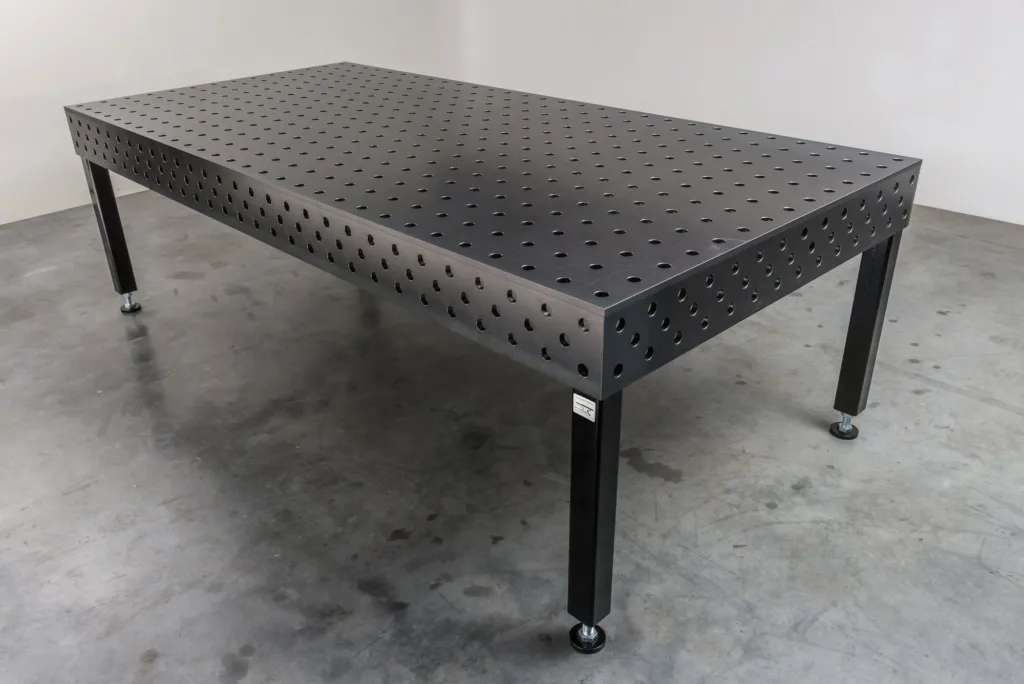
In short: Choose the format for your typical workpiece plus room for clamping tools, not for the largest single part. Long parts call for extension arms, construction bridges or a second table. A 15 mm plate suits many workshop tasks, a 25 mm plate is stiffer. The tables from die schmiede weigh approx. 215 to 1,517 kg.
A welding table should be large enough for your typical workpiece to rest on it completely, with room all around for stops and clamps. Plan at least one free row of holes on each side for this, more with large clamping squares. A frame of 1800 x 900 mm on a table of 2000 x 1000 mm, for example, leaves only 100 mm at each end and 50 mm along each long side, which is one row of holes or less in a 100 mm grid.
Do not size the table for the largest single part that rarely comes up. A large table takes up space, weighs more and has to be cleaned, even if only half of it is used most of the time. For occasional extra lengths there are extension arms and construction bridges.
| Typical workpieces | Suitable format |
|---|---|
| Small parts, brackets, jigs, training | 1000 x 1000 mm or 1200 x 800 mm |
| Racks, frames and doors up to approx. 1.5 m | 1500 x 1000 mm to 2000 x 1000 mm |
| Gates and frames up to approx. 2 m | 2400 x 1200 mm or 3000 x 1500 mm |
| Railing panels, long beams, large assemblies | 2900 x 1400 mm or 3000 x 1500 mm, joined tables or a custom size |
Welding tables from die schmiede come in formats from 1000 x 1000 mm to 3000 x 1500 mm and, according to the shop, weigh between approx. 215 and 1,517 kg. The Standard line with a 15 mm plate goes up to 2900 x 1400 mm, the PRO line with 25 mm up to 3000 x 1500 mm. Larger tables are made to order on request.
| Format | Standard 15 mm | PRO 25 mm |
|---|---|---|
| 1000 x 1000 mm | approx. 215 kg | approx. 452 kg |
| 1200 x 800 mm | approx. 215 kg | approx. 432 kg |
| 1200 x 1200 mm | approx. 316 kg | approx. 580 kg |
| 1400 x 1400 mm | approx. 435 kg | not in the shop |
| 1500 x 1000 mm | approx. 405 kg | approx. 608 kg |
| 1500 x 1500 mm | not in the shop | approx. 801 kg |
| 2000 x 1000 mm | approx. 440 kg | approx. 736 kg |
| 2000 x 1200 mm | not in the shop | approx. 794 kg |
| 2400 x 1200 mm | approx. 635 kg | approx. 986 kg |
| 2900 x 1200 mm | approx. 730 kg | not in the shop |
| 2900 x 1400 mm | approx. 895 kg | not in the shop |
| 3000 x 1500 mm | not in the shop | approx. 1,517 kg |
According to the shop, diagonally drilled PRO tables are in some cases lighter, for example approx. 1,425 kg in 3000 x 1500 mm. The two stainless steel tables in 1.4301 with 15 mm weigh approx. 240 kg (1200 x 800 mm) and approx. 400 kg (2000 x 1000 mm) according to the shop. Non-standard and larger sizes are described on Large and custom sizes.
A welding table is heavy because, besides the thick plate, the side walls, reinforcements and feet are made of steel too. As a rule of thumb, a steel plate weighs around 7.85 kg per square metre and millimetre of thickness, derived from the density of steel of approx. 7.85 kg/dm³.
On the PRO table in 2000 x 1000 mm, 200 mm high side walls, a substructure of 140 x 15 mm flat bar and four feet of 80 x 80 x 6 mm hollow section are added. That explains the total weight of approx. 736 kg according to the shop. The weight is not a disadvantage in itself: it keeps the table steady when you straighten, hammer and clamp, so it does not shift.
A 25 mm plate is stiffer, heavier and more robust against point loads, while a 15 mm plate is lighter and sufficient for many general welding and assembly tasks. In physical terms, the bending stiffness of a plate grows with the cube of its thickness: with the same material, a 25 mm plate is around four and a half times as stiff in bending as a 15 mm plate. On the finished table, side walls and substructure add to the stiffness.
| Feature | Standard 15 mm | PRO 25 mm |
|---|---|---|
| Material | S355MC, micro-alloyed fine-grain steel | S355J2+N |
| Surface | plasma nitrided | plasma nitrided, surface ground, around 850 HV |
| Holes | 28 mm, grid 100 x 100 mm | 28 mm, grid 100 x 100 mm, countersunk by 3 mm |
| Side walls | 200 mm, drilled | 200 mm, drilled, hole spacing 50 mm |
| Underside | six reinforcements of 140 x 15 mm flat bar | reinforced with 140 x 15 mm flat bar |
| Formats | 1000 x 1000 to 2900 x 1400 mm | 1000 x 1000 to 3000 x 1500 mm |
| Recommended total load | not stated in the shop | 4,000 kg on 4 feet with even distribution |
As a rule of thumb: if you mainly work on light to medium-weight frames, racks and sheet metal parts, the Standard table with 15 mm is enough. If you regularly set down heavy components, straighten on the table or need a surface-ground top, the PRO table with 25 mm is the right fit. Note that quick-release clamping bolts are matched to the plate thickness.
The load capacity of a welding table depends on plate thickness, substructure, number of feet and, above all, on how the load is distributed. For the PRO tables, die schmiede states a maximum recommended total load of 4,000 kg on four feet with even load distribution. The shop gives no value for the Standard tables, so ask in advance if you plan to work with heavy components.
Point loads stress the table more than evenly distributed loads. A heavy component on a small contact area, or hard blows when straightening, act locally on the plate. So set heavy parts down over a large area or on several support points where possible.
Think about the floor too: table weight and workpiece rest on a few feet. According to the shop, the PRO tables stand on floor pads with a diameter of 110 mm. On suspended floors, timber floors or tiles, have the load capacity checked beforehand.
The right working height is table height plus workpiece height: you should be able to work on the piece without bending over or hunching your shoulders. As a general ergonomic guide, rough, forceful work is easiest slightly below elbow height, and fine work rather slightly above.
The tables from die schmiede stand on height-adjustable feet made of structural hollow section 80 x 80 x 6 mm. According to the shop, the working height can be set from approx. 865 to 965 mm on the Standard and PRO tables and from approx. 880 to 980 mm on the stainless steel table. With the heavy-duty swivel castors from die schmiede it is 870 to 940 mm.
Two welding tables can be joined into one large work surface by bolting them together through the drilled side walls, directly with connecting bolts or via a construction bridge. According to the shop, the connecting bolts from die schmiede have a clamping range of approx. 47 to 53 mm and connect welding tables and construction bridges to each other.
For the joined surface to work like one table, both tables should have the same plate thickness and the same grid and be set to exactly the same height. Check with a straightedge whether the plates are flush at the joint, and see whether the grid continues across the joint.
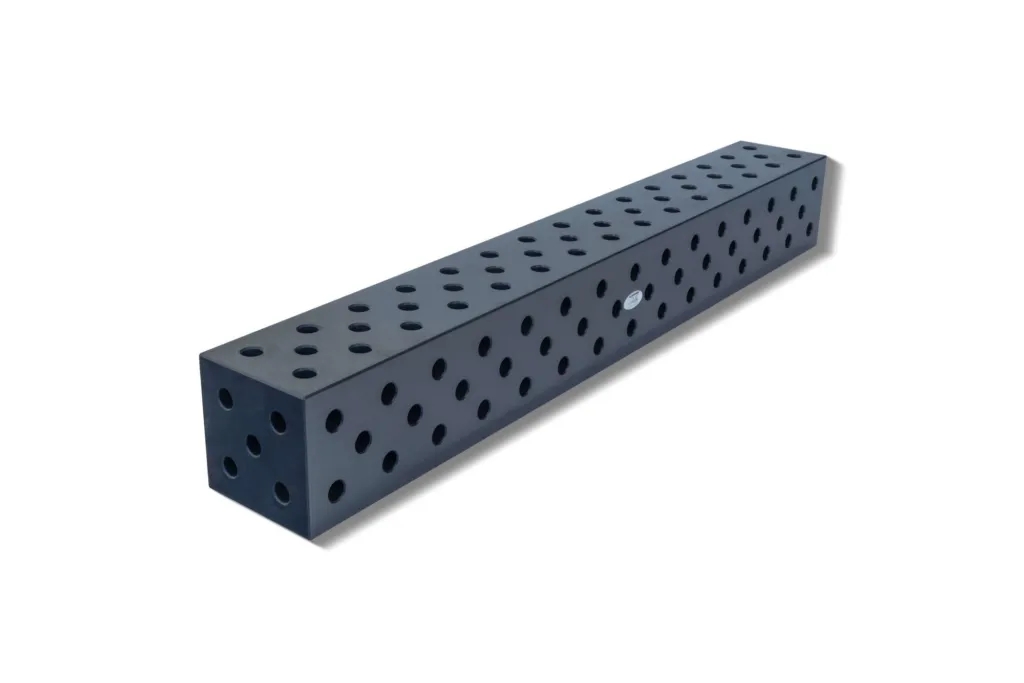
Instead of a second table, an extension arm with a length of 500 or 1000 mm is often enough for occasional extra lengths. U-angles are available for the PRO tables in lengths up to 3000 mm. All parts are listed under Extensions and construction bridges.
Besides its footprint, a welding table needs enough room to move so that you can reach the workpiece from at least two sides, better three. Also allow space for the welding machine, fume extraction, material supply and a trolley for the accessories. If you process long parts, you also need free space in front of and behind the table.
Before ordering, check the route from the gate to the final location: the top arrives in one piece on a pallet, and only the feet are fitted on site. What else to consider when buying is summed up in the buying guide.
All formats of the Standard and PRO lines with current prices are in the online shop, which is in German and delivers within Germany only. For custom sizes and for other countries, request a quote.
You calculate the weight of a steel plate as length in metres times width in metres times thickness in millimetres times 7.85, and the result is the weight in kilograms. A plate of 2000 x 1000 x 25 mm therefore weighs around 392 kg, and the holes take a little off that. On a finished table, side walls, reinforcements and feet are added.
In a small workshop, formats such as 1000 x 1000 mm or 1200 x 800 mm make sense. They offer enough surface for brackets, racks and jigs and leave room to work all around. If a workpiece is occasionally longer, an extension arm lengthens the surface without taking up space permanently. Even with small tables, expect a weight of several hundred kilograms.
The floor has to carry the weight of table, workpiece and accessories, concentrated on a few feet. It should be level and solid so that the table does not rock and the plate is not put under stress. On suspended floors, timber floors or tiles, have the load capacity checked beforehand. Height-adjustable feet or levelling castors compensate for minor unevenness.
Yes, on tables with height-adjustable feet the working height can be adjusted at any time. On die schmiede tables the range is approx. 865 to 965 mm according to the shop, and the Standard table comes with an assembly kit with Allen key and spanner for this. Set all feet evenly and then check with a spirit level that the top is level.
You level a welding table using the height-adjustable feet until the top is level both lengthways and crossways. Check with a long spirit level or precision level at several points, diagonally as well. Make sure all feet carry evenly, otherwise the plate is put under stress. Check the levelling again after moving the table or on a new floor.
If you need a large welding table, the largest series size from die schmiede is the PRO table …
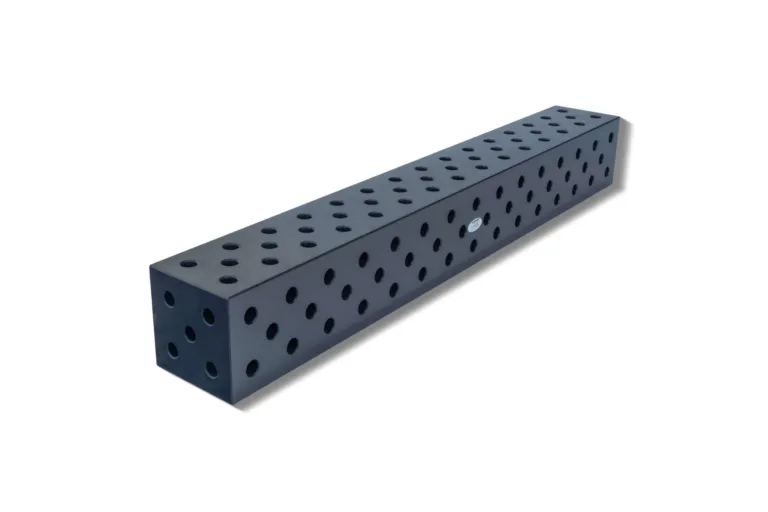
With a welding table extension, the table grows with the job: construction bridges connect two tables or serve …
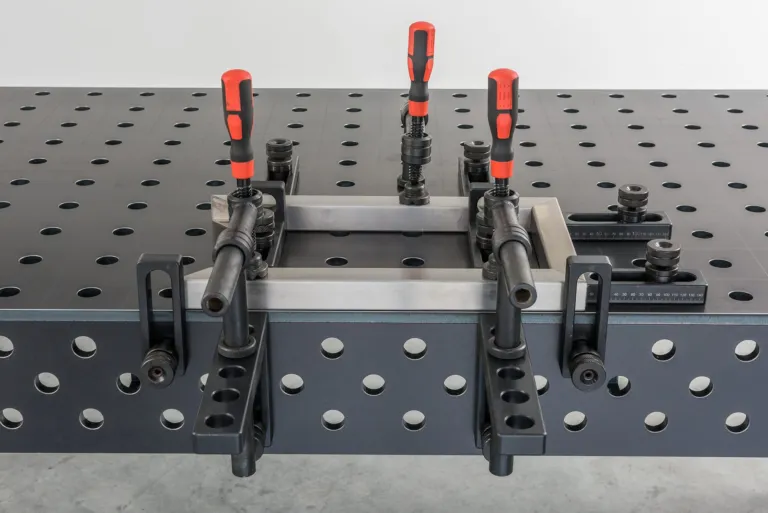
When buying a welding table, plate thickness, format and hole system matter most, followed by surface, weight, working …
5.012 reviews on Google
Ich kam mit einem kleinen außergewöhnlichen Anliegen und freue mich über so viel spontane Hilfe, Freundlichkeit und Professionalität, DANKE!
Tanja B.View on Google: review by Tanja B. (opens in a new tab)
Nicht mehr daran geglaubt - aber es gibt sie noch ! Deutsche Wertarbeit !! Rechtzeitig zum Frühlingsanfang konnten wir unsere "Wasserdichte Balkonanlage" mit Außentreppe einweihen und sind vollends begeistert von der…
Hubert L.View on Google: review by Hubert L. (opens in a new tab)
Eine Super-Schmiede, die auch Außergewöhnliche Produkte kreieren kann. Meine Kreuz, die ich zur Entstörung von Elektrosmog wurden auf Millimeter genaue Einstellung geschmiedet. Das war eine Klasseleistung! Jetzt kann ich wieder…
GoggoschelleView on Google: review by Goggoschelle (opens in a new tab)
Unsere verbogene Garagentorstange wurde sehr kurzfristig gerade gerichtet. Nettes Team. Gerne wieder.
knecht116View on Google: review by knecht116 (opens in a new tab)
Sehr kompetente Beratung ohne etwas verkaufen zu wollen! In Zukunft erste Anlaufstelle!
Wir haben im Januar einen Balkon mit Geländer und Treppe zum Garten erhalten und sind mit der Arbeit von "Die Schmiede" vollstens zufrieden. Die gesamte Abwicklung von Planung bis Montage hat problemlos geklappt. Wir können Herrn…
Daniela L.View on Google: review by Daniela L. (opens in a new tab)
Top Firma, zuverlässig, fair, preiswert, spitze Arbeit… immer wieder gerne!
Dieter H.View on Google: review by Dieter H. (opens in a new tab)
Wann immer ich Hilfe bei der Reparatur von Gartendekorationen aus Metall benötigte, wandte ich mich immer an die Schmiede. Warum? denn die Mitarbeiter sind sehr hilfsbereit und immer hilfsbereit bei Metallarbeiten. Hier sind Sie…
Super freundlich und die Schweißtische haben eine Top Qualität. Weiter so !
Michael M.View on Google: review by Michael M. (opens in a new tab)
Super höfliche Fachkräfte die tolle Arbeit geleistet haben in kurzer Zeit. Der Chef war vor Arbeitsbeginn persönlich vor Ort und jederzeit erreichbar! Qualität zu einem defitnitv fairen Preis. Top Firma! Wir sind mit unserem Zaun…
Damla K.View on Google: review by Damla K. (opens in a new tab)
Wir haben vor einem Jahr ein neues Balkongeländer von "Die Schmiede" erhalten. Alles war super, der Chef persönlich hat Maß genommen und nach nur 4 Wochen erfolgte direkt die Montage. Das alles zu einem Super Preis und man hat…
Philipp B.View on Google: review by Philipp B. (opens in a new tab)
Reviews are shown in their original language (German). This is a selection of the most recent Google reviews with 4 or 5 stars and a written comment (up to 12). Reviews have not been checked for authenticity.