
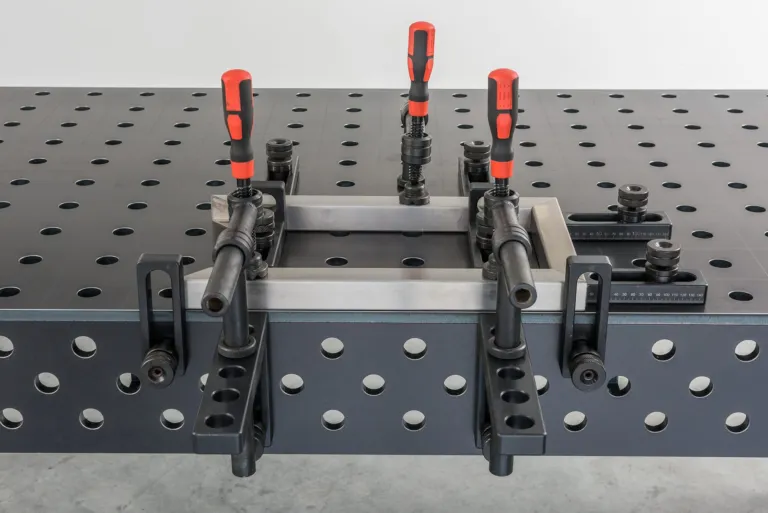
Buying a welding table
When buying a welding table, plate thickness, format and hole system matter most, followed by surface, weight, working …
Frequently asked questions
All frequently asked questions on this website in one place: first ordering, payment and advice, then the questions on tables, accessories, guide topics and quotes, grouped by page.
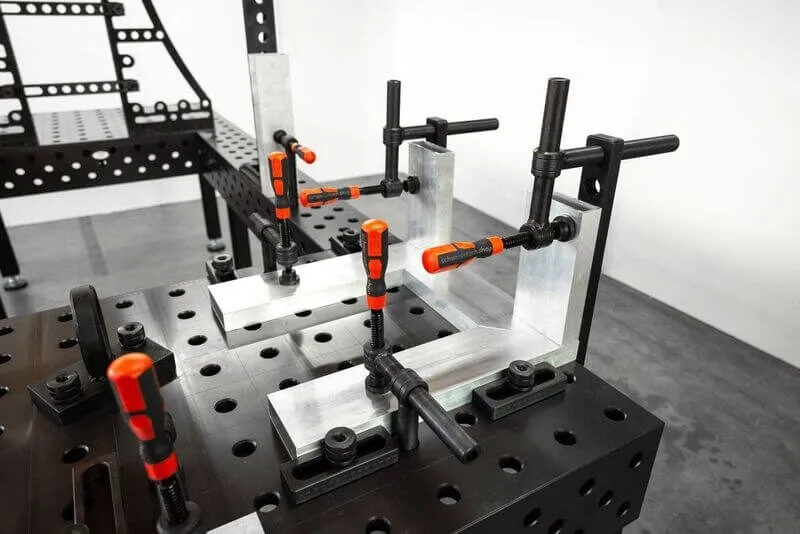
The general questions on ordering, payment and advice come first; they are based on the terms and conditions and the FAQ of the online shop. Below them follow the questions from the individual pages, grouped by topic, each with a link to its page.
Technical questions on table size, plate thickness, hole system or care are covered in detail in the guides:
The binding documents are the terms and conditions, the cancellation policy and the shipping information of the online shop. The online shop and these documents are in German, and the shop delivers within Germany only.
Yes, according to the terms and conditions you can place an order not only in the online shop schweisstisch.shop but also by email, fax, contact form, post or phone. The order can be accepted within five days by an order confirmation, a request for payment or delivery of the goods. If you are based outside Germany, use the quote request on the contact page.
According to the shop FAQ, you can pay in advance by bank transfer, with PayPal or by credit card. For payment in advance, transfer the amount to the account given in the order confirmation, with your order number as the payment reference; the goods are dispatched once payment has been received. The checkout shows which payment methods are currently enabled.
Yes, the goods come with an invoice. Prices in the shop are gross prices including 19 % German VAT, and the product descriptions also state the net price, which makes calculation easier for businesses. For custom sizes and orders from outside Germany, die schmiede prepares an individual quote on request.
Consumers have a 14-day right of withdrawal from receipt of the goods. The buyer bears the cost of returning the goods; for freight items this cost depends on the weight and is estimated in the cancellation policy. If you want to change or cancel an order, get in touch as soon as possible, because die schmiede processes orders shortly after they are placed and arranges the logistics.
The quickest way is by phone on +49 9332 591512 or on the mobile number +49 170 1600369. In writing, use info@dieschmiede.com or the form on the contact page. Advice covers table size, accessories, extensions and custom sizes, as well as quotes for orders from outside Germany.
As a rule, yes, provided they are made for the 28 mm hole system. The tables have holes with 28 mm diameter in a 100 x 100 mm grid, a widely used industry standard. Conversely, according to the shop, die schmiede accessories are compatible with other tables built around the 28 mm system. For clamping bolts, check that they match the thickness of the table top.
Go to the page: Welding tables by die schmiede
A welding table with holes is a work table made from a thick steel plate with bores at fixed spacing. On die schmiede tables the bores are 28 mm in diameter and sit in a 100 x 100 mm grid. You insert stops, clamping squares and clamps into the bores and clamp parts repeatably with accurate dimensions and angles. The drilled side walls let you build vertically as well.
There are two lines of plasma nitrided steel tables, Standard with a 15 mm plate and PRO with a 25 mm plate, plus a stainless steel table, an octagonal table and custom sizes. The stainless steel table is made of 1.4301, the octagonal table is designed for robot cells, and custom sizes are made on request. All tables have 28 mm bores. An overview of all sizes is on the welding tables page.
All die schmiede welding tables have 28 mm bores in a 100 x 100 mm grid, measured from bore centre to bore centre. The shop calls this System 28. Both the table top and the 200 mm high side walls are drilled. On the PRO tables the bores in the side walls are 50 mm apart, which gives more positions for clamping from the side.
No, the table is also a clamping and assembly table. Parts can be aligned, clamped, tacked and assembled on it. Besides metalworking businesses, die schmiede explicitly names wood and plastics processing businesses as users. For robot cells there is an octagonal table measuring 1000 x 1000 x 200 mm, which is designed for use on manipulators.
A die schmiede welding table weighs approx. 215 to 1,520 kg, depending on size and plate thickness. According to the shop, a Standard table with a 15 mm plate in 2000 x 1000 mm weighs approx. 440 kg, and a PRO table with a 25 mm plate in the same size approx. 736 kg. Because of this weight, the tables are shipped on a pallet by freight forwarder.
Yes, by requesting a quote: delivery to other countries is arranged by freight forwarder on request. The online shop schweisstisch.shop is in German and delivers within Germany only. Send the size, plate thickness, accessories and the delivery country and town through the contact form, and die schmiede will prepare an individual quote. Freight is delivered to the kerbside, so you need a forklift on site for unloading.
Go to the page: Welding tables
In the shop, the Standard table comes in nine sizes from 1000 x 1000 to 2900 x 1400 mm and the PRO table in nine sizes from 1000 x 1000 to 3000 x 1500 mm. The stainless steel table is available in 1200 x 800 and 2000 x 1000 mm, the octagonal table in 1000 x 1000 x 200 mm. Other dimensions are made on request.
Standard has a 15 mm plate in S355MC, PRO a 25 mm plate in S355J2+N. Both are plasma nitrided and have 28 mm bores in a 100 x 100 mm grid. The PRO plate is also surface ground, has a surface hardness of approx. 850 HV, countersunk bores and a recommended total load of up to 4,000 kg. Diagonal holes are only available on PRO tables.
Yes, but only the legs. The table arrives compactly on a pallet, and the plate is already drilled and reinforced. You fit the legs with the tools supplied and set the working height between approx. 865 and 965 mm. You need a forklift to unload the table from the freight forwarder's lorry.
Go to the page: Stops and clamping squares
A universal stop is a flat bar that limits the workpiece in the table plane, on the top or on the side wall. An angle stop and clamping square also has a vertical leg and therefore sets a reference edge in height; larger squares also serve as table extensions. For flat frames, universal stops are often enough, and for three-dimensional assemblies you add clamping squares.
The PRO squares 300 L to 750 L and R are intended for large parts: at 75 mm wide, 200 mm high and 27 mm thick, they are considerably sturdier than the Standard squares, which are 50 mm wide. According to the shop, they work as a stop for large parts or as an extension of the welding table. Each is fixed with 2 countersunk clamping bolts designed for PRO tables with a 25 mm top.
Yes, the shop recommends ordering the GK squares 300, 600 and 800 in pairs. Each size comes in a left-hand and a right-hand version, so a pair can be set up as mirror images. The GK squares are up to 800 mm high, 95 mm wide and cast from GGG40; each square is fixed with 2 flush clamping bolts.
That depends on the slot: 0 to 100 mm on the 150 L, 225 L and 525 L, 0 to 200 mm on the 250 L and 0 to 220 mm on one version of the 325 L. As the grid holes are 100 mm apart, a 100 mm slot already covers every intermediate dimension. Models 150 and 250 without a slot are moved in steps of 50 mm.
An eccentric stop is a round stop disc that sits off-centre in a system hole, so turning it changes the distance to the contact edge. The eccentric stop 100 from die schmiede has a 100 mm diameter, is 25 mm thick and nitrided. According to the shop, it fixes components quickly, steplessly and in a space-saving way simply by turning. It is also included in accessory sets 3.0 and 4.0.
Go to the page: PRO welding table 25 mm
The table top of the PRO welding table is 25 mm thick. It is made of S355J2+N, plasma nitrided and surface ground, and according to the manufacturer has a surface hardness of approx. 850 HV. The side walls are 200 mm high and also drilled. For comparison, the Standard line has a 15 mm plate in S355MC.
A PRO welding table weighs approx. 430 to 1,520 kg, depending on size. According to the shop, the table measuring 1200 x 800 mm weighs approx. 432 kg, the one measuring 2000 x 1000 mm approx. 736 kg and the one measuring 3000 x 1500 mm approx. 1,517 kg. The weights of all sizes are in the table on this page.
For the PRO welding table, die schmiede recommends a total load of no more than 4,000 kg, on four feet and with the load evenly distributed. The shop gives no figure for the Standard line. If you plan very heavy or concentrated point loads, clarify this with die schmiede in advance.
With diagonal holes, the plate has a diagonal hole pattern in addition to the 100 x 100 mm grid. According to the manufacturer, parts can be clamped more flexibly this way, and sometimes you need fewer stops and clamps. The version is available in seven PRO sizes from 1000 x 1000 to 3000 x 1500 mm, with the same plate and the same material.
Yes. The side walls of the PRO table are 200 mm high and have 28 mm bores at 50 mm spacing. Stops, clamping squares and U-angles PRO can be fixed there to extend the working area or to build vertically. The side wall therefore works as a second clamping surface.
Go to the page: Buying a welding table
For beginners, a fixture table with a 15 mm plate in a medium format such as 1200 x 800 mm or 1500 x 1000 mm is a good choice. It is lighter than a table with a 25 mm plate, takes up less space and can be expanded later with extension arms or a second table. What matters is choosing a system from the start for which you can buy further accessories.
Yes, a fixture table pays off as soon as you regularly weld frames, racks or similar assemblies. The visible grid shows right angles at a glance, and stops and clamps hold the parts accurately in position. That saves measuring time when tacking and reduces rework. The table shows its strengths with one-off pieces as well as with small batches.
No, to start with, a few clamping bolts, two or three stops or clamping squares and a few screw clamps are enough. With these, most frames and angle joints can be set up securely. Larger sets pay off once you know which tasks come up regularly, or when several people work at the table at the same time. Make sure the accessories match your plate thickness.
You recognise a high-quality welding table by traceable technical data: material, plate thickness, surface treatment, grid pitch, side wall height and the design of the substructure. Good signs are a machined and hardened surface, chamfered holes, a reinforced underside and stable, height-adjustable feet. If such information is missing, ask the manufacturer before you order.
No single model suits every workshop: the right welding table is the one whose plate thickness, format and hole system match your workpieces and the accessories you already own. For general workshop tasks a 15 mm plate is often enough, for heavy components and high clamping forces a 25 mm plate is stiffer. Compare each candidate against the ten points of the checklist above.
Yes, a welding table with drilled side walls can be enlarged afterwards. Extension arms lengthen the work surface, and construction bridges or connecting bolts join two tables into one large surface. When buying more, choose the same hole system and the same plate thickness, so that grid and clamping tools match and both tables can be set to the same height.
Castors make sense if you need to move the table around the workshop or between workstations. Look for sufficient load capacity per castor, brakes and levelling for uneven floors. For heavy tables and work involving high forces, standing firmly on feet is usually the more stable solution, because the table cannot then shift.
Typical mistakes are a format that is too small to leave room for clamping tools, a hole system that does not match your existing accessories, and an underestimated weight for unloading and installation. Accessories should also be planned from the start, because only with them does a fixture table show its advantages. Go through the checklist above point by point.
Go to the page: System 16 or System 28
No, the accuracy of a welding table does not depend on the hole diameter but on how it is made: flatness of the plate, dimensional accuracy of the holes and evenness of the grid. The finer grid of System 16 offers more positions on a small area, but it does not automatically make components more accurate. In System 28, stops with a millimetre scale compensate for the coarser grid.
For hobby welders, the choice depends mainly on the workpieces. If you weld small parts, brackets or thin sheet, System 16 works well and saves weight. If you build trailers, gates, stairs or heavy frames, System 28 is the better fit. Bear in mind that a System 28 table weighs several hundred kilograms and needs a floor that can carry it.
Yes, small parts can also be positioned securely on a System 28 table, for example with short stops, V-blocks and clamps. The coarser grid is compensated by stops with a millimetre scale or with several system holes, which are 50 mm apart on the universal stops from die schmiede. For very small, delicate parts, however, System 28 accessories are comparatively heavy.
System 22 is an intermediate size with 22 mm holes offered by some manufacturers. It is aimed at users who find System 16 too light and System 28 too heavy. Here too, accessories only fit their own hole diameter. Before buying, check how large the range of accessories is in the system you want and whether you will still be able to buy parts in a few years.
A switch is worth it if your components get heavier and System 16 reaches its limits in clamping force or plate stiffness. Bear in mind that your existing accessories cannot be used on the new table. A practical solution is to keep the System 16 table for small parts and add a second table in System 28 for heavy work.
The shop names two kinds of accessories for the side walls: universal stops are expressly intended as stops for the side holes, and construction bridges (U-angles) are bolted to the side walls of the tables. Because the side walls are drilled like the table top, they also allow vertical set-ups. This means you can use the sides as clamping and stop surfaces in addition to the top.
Both: every part is available individually in the shop, alongside the starter set and accessory sets 1.0 to 4.0 with 24 to 53 parts. In its special offers, die schmiede also sells multipacks, for example sets of 10 professional 90° screw clamps, quick-release clamping bolts or universal stops, and a set of 5 professional 45° screw clamps.
A V-block, also called a prism, holds round and square tubes so that they stay in a defined position during tacking and welding. It is inserted into a system hole. die schmiede offers prisms with 60 and 80 mm diameter, milled at 90°, and the Vario prism 50 with supports at 90° and 120°. Accessory sets 3.0 and 4.0 contain two prisms with 60 mm diameter.
The earth clamp is fixed directly in a system hole of the table and so creates a reliable contact between the welding machine and the table. According to the shop, this makes mounting quick and easy. It comes in two versions, for Standard tables with a 15 mm top and for PRO tables with a 25 mm top. Choose the version in the shop that matches your table.
Go to the page: Clamps and clamping bolts
That depends on the thickness of the table top: for PRO tables with a 25 mm top, choose the quick-release clamping bolt with art. no. 28-4-0001-25, for Standard tables with 15 mm the one with art. no. 28-4-0001-15. Both have a 28 mm diameter and, according to the shop, a length of 95 mm. For tables from other manufacturers with a 28 mm system, measure the thickness of the top before ordering.
The professional screw clamp 90° clamps up to 200 mm high, the version with high clamping range up to 340 mm and the professional screw clamp 45° up to 240 mm. All three are pushed through a 28 mm hole and can be rotated steplessly through 360°. Choose the clamp according to the height of the components you clamp most often.
A magnetic clamping bolt clamps without tools and, according to the shop, is suitable for pressure-sensitive parts or places where no counterhold is possible. The magnetic clamping bolt from die schmiede is made of aluminium, 68 mm long, has a shank length of 25 mm and weighs 0.09 kg. The shop lists it for PRO welding tables with a 25 mm top.
The quick-release clamping bolt holds stops and squares on the table and is locked by a twist lock with locking balls. At 50 mm, the connecting bolt is considerably shorter and creates a concealed connection between two components, for example a welding table and a construction bridge. Its clamping range is approx. 47 to 53 mm, and it is designed for PRO tables.
Go to the page: Standard welding table 15 mm
The top of the Standard welding table is 15 mm thick. It is made of micro-alloyed fine-grain steel S355MC and plasma nitrided. The underside is also reinforced six times with 140 x 15 mm flat bar, and the side walls are 200 mm high and drilled. The PRO line, by contrast, has a 25 mm plate in S355J2+N.
The Standard welding table is available in nine sizes: 1000 x 1000, 1200 x 800, 1200 x 1200, 1400 x 1400, 1500 x 1000, 2000 x 1000, 2400 x 1200, 2900 x 1200 and 2900 x 1400 mm. This gives a working area from 0.96 to 4.06 m². Other dimensions are made on request.
According to the shop, a Standard welding table weighs approx. 215 to 895 kg, depending on size. The sizes 1000 x 1000 and 1200 x 800 mm weigh approx. 215 kg, the table measuring 2000 x 1000 mm approx. 440 kg and the one measuring 2900 x 1400 mm approx. 895 kg. In the same size it is considerably lighter than a PRO table.
The working height of the Standard welding table can be set between approx. 865 and 965 mm. The four legs in 80 x 80 x 6 mm structural hollow section are height-adjustable for this, and the tools are supplied as an assembly kit. If you need a different height, die schmiede makes individual table legs on request.
Both have a 15 mm plate with 28 mm bores, but in different materials. The Standard table is made of plasma nitrided fine-grain steel S355MC and is available in nine sizes. The stainless steel table is made of 1.4301 and is intended for workshops that process a lot of stainless steel. It comes in 1200 x 800 and 2000 x 1000 mm, with a working height of approx. 880 to 980 mm.
Go to the page: Accessory sets
The starter set consists of three parts: a 90° screw clamp, a blackened quick-release clamping bolt with twist lock and an angle stop and clamping square 275 L. According to the product pages, it is already included with many welding tables in the shop, and it is also available separately for 15 mm and 25 mm tops. For more clamping points, add an accessory set or individual parts.
Set 4.0 has 10 more parts than set 3.0, 53 instead of 43. It adds 2 quick-release clamping bolts (14 instead of 12), 2 universal stops 325 mm, 2 angle stops and clamping squares 75 L and 2 more clamping squares each in 175 and 275 mm. Clamps, universal stops 150 and 225 mm, prisms, eccentric stop and care products are the same in both sets.
Set 2.0 has 8 more parts than set 1.0, 32 instead of 24. It contains 6 instead of 4 screw clamps, 12 instead of 8 quick-release clamping bolts and, in addition, 2 angle stops and clamping squares 175 mm. Universal stops, torch holder, hole brush, anti-spatter lotion and cleaner are the same in both sets. With the clamping squares, set 2.0 also lets you build upwards.
Yes, according to the shop the accessory trolley has room for the complete 53-part accessory set 4.0. The trolley measures 650 x 900 x 1020 mm, runs on 4 castors and is supplied without accessories. Set and trolley are ordered separately, so add both to your order or quote request.
Yes, the special offers include PRO welding tables together with an accessory set: as of 19 November 2026, sizes 1500 x 1000, 2400 x 1200 and 3000 x 1500 mm with set 3.0 and 2000 x 1000 mm with set 2.0. Alternatively, add the table and the set to the basket separately, or request a quote for both.
Go to the page: Plasma nitriding explained
No, a plasma nitrided welding table is not rustproof. The nitrided layer improves corrosion protection compared with bare steel, but moisture, condensation or sweat from hands can still cause flash rust. Keep the table dry, remove flash rust early and protect the surface with a thin film of oil when it stands unused for longer periods.
Grinding large areas makes no sense, because the hardened surface layer only reaches a few tenths of a millimetre deep and is lost wherever material is removed. What remains is softer steel that wears and rusts faster. Stubborn spatter is better removed with a scraper or a honing stone held flat. Discuss deep damage with the manufacturer.
HV stands for Vickers hardness. In this test, a diamond pyramid is pressed into the surface with a defined force and the indentation is measured. The higher the value, the harder the surface. For its PRO tables, die schmiede states around 850 HV. Values from different manufacturers are only comparable if the test load and measuring method are known.
In principle, yes: heat treatment shops offer plasma nitriding as a subcontract service, provided the plate fits into the furnace. Spatter, rust, oil and paint must be removed completely beforehand. Existing distortion or damage remains, because nitriding only hardens the existing surface. Clarify size, weight and effort with the heat treatment shop in advance.
Plasma nitriding changes the dimensions only very slightly, because it works without quenching and at a comparatively low temperature. The uptake of nitrogen can make the surface grow minimally, and residual stresses in the material can have a slight effect. That is why the plate is usually machined to its final state before nitriding, so that holes and flatness are right afterwards.
Go to the page: Large and custom sizes
From 2400 x 1200 mm upwards there are five large series sizes: Standard with a 15 mm plate in 2400 x 1200, 2900 x 1200 and 2900 x 1400 mm, and PRO with a 25 mm plate in 2400 x 1200 and 3000 x 1500 mm. Both PRO sizes are also available with diagonal holes. Anything larger is a custom build on request.
According to the shop, the PRO welding table measuring 3000 x 1500 mm weighs approx. 1,517 kg, and the version with diagonal holes approx. 1,425 kg. It stands on six height-adjustable feet and is delivered by freight forwarder. You need a forklift for unloading, and for moving the table the shop offers a transport bracket with a load capacity of 2,500 kg.
Yes, die schmiede builds welding tables in custom sizes on request, larger or smaller than the series sizes. State length, width, plate thickness, working height and hole pattern. Custom sizes are not ordered through the shop but through a direct request by phone, email or contact form. You then receive an individual quote.
Yes. According to the shop, die schmiede also supplies tables without legs on request, for example for your own base frame. It also makes individual table legs, for instance for a working height outside approx. 865 to 965 mm. Both are handled through a direct request, not through the shopping basket.
That depends on whether you need a continuous plate. One large table gives you a hole grid without a joint across the entire surface. Coupled tables can be extended later, separated again and moved individually, and the U-angles between them also serve as vertical clamping surfaces. From 1000 mm angle length an additional table leg is required.
An octagonal table is a clamping table with an eight-sided footprint and a hole grid on the top and on all eight side faces. The octagonal table from die schmiede measures 1000 x 1000 x 200 mm, has a 25 mm plasma nitrided plate in S355J2+N and weighs approx. 355 kg. It is designed for manipulators in robot cells.
The guide explains technology and selection criteria that stay valid for years, whereas prices change with material costs, promotions and the product range. To keep outdated figures out of circulation, current prices are shown only in the die schmiede online shop, which is in German. If you need a figure for a specific project, request a quote via the contact page.
Yes, the general advice on selection, hole systems, surfaces, care and DIY builds applies to fixture tables from any manufacturer. Figures such as weights, formats, working heights or hardness values, on the other hand, refer explicitly to die schmiede tables and are marked as such in the text. For tables from other manufacturers, check their own specifications.
The technical data on die schmiede tables reflects the online shop as of 19 November 2026, and every article shows its update date. If the shop data changes later, the shop takes precedence, because that is where die schmiede maintains its product range and product data on an ongoing basis.
Go to the page: Size and plate thickness
You calculate the weight of a steel plate as length in metres times width in metres times thickness in millimetres times 7.85, and the result is the weight in kilograms. A plate of 2000 x 1000 x 25 mm therefore weighs around 392 kg, and the holes take a little off that. On a finished table, side walls, reinforcements and feet are added.
In a small workshop, formats such as 1000 x 1000 mm or 1200 x 800 mm make sense. They offer enough surface for brackets, racks and jigs and leave room to work all around. If a workpiece is occasionally longer, an extension arm lengthens the surface without taking up space permanently. Even with small tables, expect a weight of several hundred kilograms.
The floor has to carry the weight of table, workpiece and accessories, concentrated on a few feet. It should be level and solid so that the table does not rock and the plate is not put under stress. On suspended floors, timber floors or tiles, have the load capacity checked beforehand. Height-adjustable feet or levelling castors compensate for minor unevenness.
Yes, on tables with height-adjustable feet the working height can be adjusted at any time. On die schmiede tables the range is approx. 865 to 965 mm according to the shop, and the Standard table comes with an assembly kit with Allen key and spanner for this. Set all feet evenly and then check with a spirit level that the top is level.
You level a welding table using the height-adjustable feet until the top is level both lengthways and crossways. Check with a long spirit level or precision level at several points, diagonally as well. Make sure all feet carry evenly, otherwise the plate is put under stress. Check the levelling again after moving the table or on a new floor.
Go to the page: Extensions and construction bridges
A construction bridge is a U-shaped steel profile with holes in the top and side walls that connects two welding tables or serves on the table as a vertical construction and clamping aid. At die schmiede it is called a U-angle (Winkel U-Form), is 200 mm wide and 200 mm high and is bolted to the side walls of the tables. It is available nitrided up to 1600 mm and as a PRO version up to 3000 mm.
According to the shop, from a length of 1000 mm: support from a table leg is then required. The table leg from die schmiede is made of 80 x 80 x 6 mm structural hollow section, can be adjusted for working heights of approx. 860 to 980 mm and has a floor pad with 110 mm diameter. It is available separately under art. no. 28-1-0015.
Each heavy duty castor carries 700 kg according to the shop, and they are supplied as a set of 4. The castors have a 150 mm wheel diameter, are hot-dip galvanised, can be levelled for uneven workshop floors and are height-adjustable from 870 to 940 mm. Before ordering, check the total weight of table, accessories and workpieces.
Standard lengths are listed in the shop, and custom lengths can be requested from die schmiede. The nitrided U-angle comes in 500, 1000, 1200 and 1600 mm, the PRO version in 500, 1000, 1500, 2000 and 3000 mm. Lengths between 1000 and 2900 mm have previously been offered on request. For a custom length, send your required dimensions via the contact form or by email.
The large corner connection extends a welding table diagonally at an angle of 45°. It is cast from GGG40, nitrided, measures 200 x 200 x 170 mm and weighs 15.7 kg. You will find it under art. no. 28-8-0003-25 in the extensions collection of the online shop.
Go to the page: Stainless steel welding table
The shop lists the stainless steel welding table in two sizes: 1200 x 800 mm with 0.96 m² of working area and 2000 x 1000 mm with 2 m². Both have a 15 mm plate in 1.4301 and 28 mm bores in a 100 x 100 mm grid. According to the manufacturer, other dimensions in stainless steel are possible on request.
The table top is made of stainless steel 1.4301, often called V2A in Germany and broadly comparable to AISI 304. It is an austenitic, corrosion-resistant chromium-nickel steel. The plate is 15 mm thick and reinforced with flat bar on the underside. The legs are made of 80 x 80 x 6 mm structural hollow section in RAL 9005 jet black.
A stainless steel welding table is worth it if you mainly process stainless steel and want to avoid iron contamination. On a plate of carbon steel, iron particles can transfer to stainless parts and rust there later. Typical examples are stainless railings and stairs or parts for food processing and plant engineering. For mainly carbon steel work, the plasma nitrided tables are the obvious choice.
According to the shop, the stainless steel welding table weighs approx. 240 kg in 1200 x 800 mm and approx. 400 kg in 2000 x 1000 mm. It stands on four height-adjustable legs, and the working height can be set between approx. 880 and 980 mm. It is delivered by freight forwarder, and you need a forklift for unloading.
Yes. As on the steel tables, the bores are 28 mm in diameter, and at 15 mm the plate is as thick as on the Standard table. So choose quick-release clamping bolts and accessory sets in the version for 15 mm. Bear in mind that most clamping tools are nitrided or black oxide finished, so they are made of steel and touch your stainless parts.
The manufacturer is die schmiede GmbH, Am Traugraben 4, 97342 Marktsteft, Germany, registered at the Würzburg local court under HRB 11891. The metalworking business from Lower Franconia makes the welding tables with a 28 mm hole grid itself and sells them together with accessories and extensions. Custom sizes are made on request.
According to its company website, die schmiede is a master metalworking business (Meisterbetrieb) and has been certified to DIN EN 1090 since 2015. The certificate allows it to manufacture load-bearing components such as stairs, balconies and railings. It relates to the business and its metalwork; it is not a product certificate for the welding tables.
Apart from welding tables, die schmiede makes railings, fences, gates, canopies and stairs to measure for industry, exhibition stand construction and private clients, and restores old metalwork. The business processes steel, stainless steel, glass and aluminium. These metalwork projects are mainly located in the region between Würzburg, Schweinfurt and Nuremberg.
Current insights from the workshop in Marktsteft are shared on Instagram at @die_schmiede_marktsteft. Photos of the welding tables are in the gallery on this website, and videos about set-up and extensions are on the videos page. The metalwork services are presented on the company website dieschmiede.com.
Go to the page: Care and cleaning
Clean a welding table mechanically and with a degreasing cleaner. Push off spatter with a spatula or scraper, clean the holes with a hole brush, and remove grease and dirt with a cleaner and a clean cloth. Avoid angle grinders, acids and chlorine-based products, and let the surface dry thoroughly afterwards.
Yes, a thin film of acid-free oil protects the steel surface against flash rust, especially when the table stands unused for longer periods or in cold workshops. Apply the oil sparingly and wipe off the excess. Before welding, the surface in the work area should be free of oil, because oil smokes under heat and can carry contamination into the weld.
Yes, die schmiede recommends anti-spatter spray for its plasma nitrided tables too, even though weld residue is easy to remove from them. The thin film stops spatter from burning on, so cleaning takes less time on the table, the clamping tools and the workpiece. Apply it thinly around the weld area and keep it out of the weld joint.
Apply anti-spatter spray around the weld area before every welding job, meaning on the table and clamping tools within the spatter zone. During longer jobs, reapply as soon as spatter starts to stick again. A thin, even film is enough. Make sure no anti-spatter agent gets into the weld joint, because residue in the seam can cause porosity.
Yes, light flash rust can be removed without significantly attacking the nitrided layer. Use a cleaner and a fine abrasive fleece, held flat and without pressure. Coarse abrasives and angle grinders, by contrast, remove the hard surface layer. Afterwards, clean, dry and lightly oil the surface so that the rust does not come straight back.
If a quick-release clamping bolt jams, the cause is often spatter, slag or rust in the hole or on the locking balls. Release the bolt without force, clean the hole with a hole brush and the bolt with a cleaner, and oil it lightly. Never drive bolts in with a hammer, as this damages the bolt and the edge of the hole.
You request a quote through the contact form on this page, by email to info@dieschmiede.com or by phone on +49 9332 591512. Describe the table or accessories you need and give the delivery country. The team checks the request and sends you an individual quote. This is the way to order from outside Germany, because the online shop delivers within Germany only.
Helpful details are the size and plate thickness, the quantity, the accessories you need and the delivery country with postcode and town, because freight costs depend on weight and distance. Also state whether a forklift is available for unloading, as freight is delivered to the kerbside. For custom builds, briefly describe the intended use, such as part sizes or special requirements for legs and height.
The thicker the plate, the stiffer it is and the less it distorts when side walls and frame are welded on. For a simple table without a hole grid, the thickness depends on your workpieces and the material available. If the table is to take system accessories, choose a thickness for which clamping bolts exist, in System 28 usually 15 or 25 mm.
As preparatory work yes, as finished holes usually not. Plasma-cut holes are often slightly tapered, have a rough, hardened cut edge and deviate in diameter. Quick-release clamping bolts, on the other hand, need a cylindrical, accurate hole. If you pre-cut holes thermally, bring them to final size with an annular cutter or on a drilling machine and chamfer them.
Distortion cannot be prevented completely, but it can be reduced considerably. Tack symmetrically, weld short seams alternately and let the work cool down in between. Fix the plate on a flat base and bolt the frame where possible. A thick plate distorts less than a thin one. Check flatness with a straightedge and feeler gauge.
You should not use galvanised steel for the work surface. During welding and heating the zinc vaporises, and the fumes are harmful to health and can cause metal fume fever. Zinc near the seam also promotes porosity. For frame parts outside the welding area, galvanised material is less critical, but the work surface should be bare steel.
In terms of material, a DIY build is often cheaper, but not necessarily in the overall calculation. Besides the plate, there are sections, drilling tools, possibly subcontract work for drilling, surface machining and nitriding, and many hours of your own working time. Add these items up honestly and compare them with current prices for finished tables. For a simple table without a hole grid, the calculation is more likely to work out.
Go to the page: Fixture table, clamp table, 3D welding table
A fixture table is a type of welding table, but not every welding table is a fixture table. Welding table is the umbrella term for any sturdy steel table used for welding, including tables with a plain top. A fixture table has system holes in a fixed grid in which clamping tools are fixed, so parts can be positioned repeatably. In everyday sales language, both terms are often used for the same product.
Not always. In welding, clamp table usually means a fixture table on which workpieces are clamped through the system holes. The same words are also used for woodworking benches with holes or rails for clamps and for machine clamping tables with T-slots. A woodworking clamp table is not designed for welding heat, spatter or as an earth connection, so check the material and intended use before buying.
Often, yes: both terms describe a welding table with system holes in a fixed grid on which clamping tools are fixed. Modular emphasises that table, clamping tools and extensions form a system that can be reconfigured and extended. Before buying, compare hole diameter, grid pitch, plate thickness and side wall height rather than the product name, because these figures determine which accessories fit.
The name 3D welding table refers to the fact that components can be clamped in all three spatial directions. This is made possible by system holes not only in the table top but also in the side walls. Stops, angles and bridges can be attached there, so that vertical and laterally projecting set-ups are also held firmly and accurately.
In machining, a jig traditionally guides the cutting tool, while a fixture only holds the workpiece in position. In welding, the two words are largely used interchangeably for set-ups that hold parts in the correct position for tacking and welding. A welding jig table or welding fixture table is the base on which such set-ups are built from stops, clamping squares and clamps.
It depends on who uses the term. Some sellers use welding bench as a plain synonym for welding table. In its more specific sense, a welding bench is a workbench with a steel top for smaller welding, grinding and assembly jobs, often with a vice or shelf and without a hole grid. For dimensionally accurate assemblies, a fixture table with a clamping system is the more suitable choice.
When buying a welding table, plate thickness, format and hole system matter most, followed by surface, weight, working …
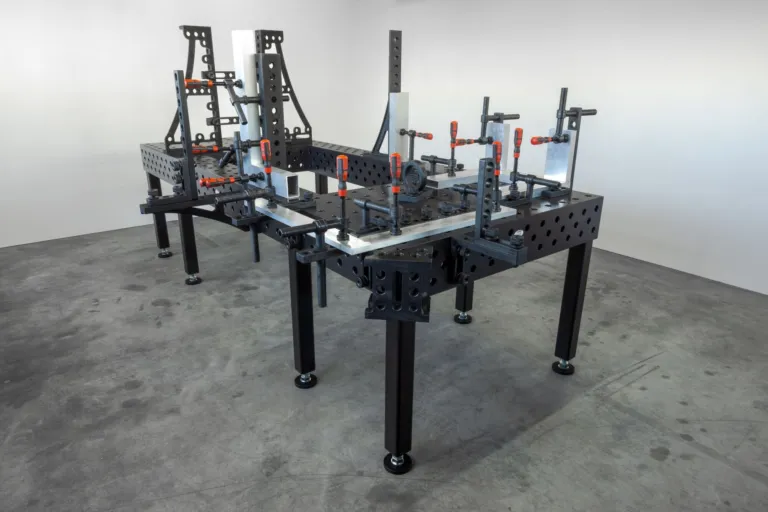
This welding table guide answers practical questions about welding tables with a hole grid: buying, hole systems, surface …
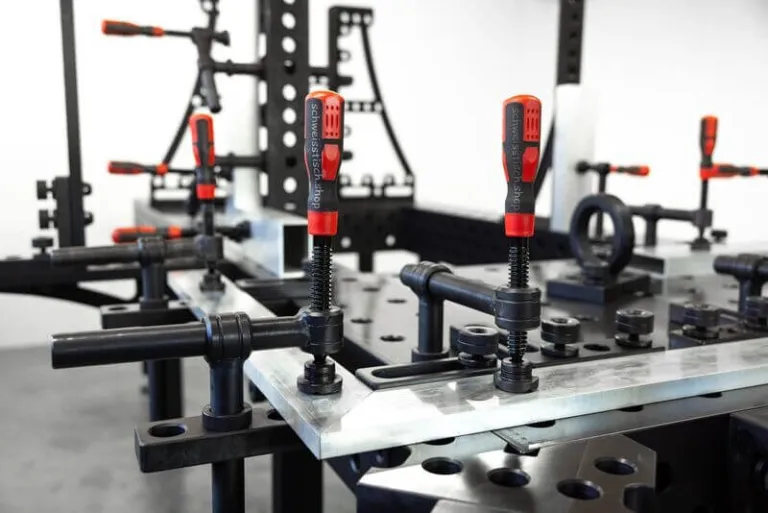
Do you need a welding table quote, a custom size or delivery outside Germany? Call die schmiede on …
5.012 reviews on Google
Ich kam mit einem kleinen außergewöhnlichen Anliegen und freue mich über so viel spontane Hilfe, Freundlichkeit und Professionalität, DANKE!
Tanja B.View on Google: review by Tanja B. (opens in a new tab)
Nicht mehr daran geglaubt - aber es gibt sie noch ! Deutsche Wertarbeit !! Rechtzeitig zum Frühlingsanfang konnten wir unsere "Wasserdichte Balkonanlage" mit Außentreppe einweihen und sind vollends begeistert von der…
Hubert L.View on Google: review by Hubert L. (opens in a new tab)
Eine Super-Schmiede, die auch Außergewöhnliche Produkte kreieren kann. Meine Kreuz, die ich zur Entstörung von Elektrosmog wurden auf Millimeter genaue Einstellung geschmiedet. Das war eine Klasseleistung! Jetzt kann ich wieder…
GoggoschelleView on Google: review by Goggoschelle (opens in a new tab)
Unsere verbogene Garagentorstange wurde sehr kurzfristig gerade gerichtet. Nettes Team. Gerne wieder.
knecht116View on Google: review by knecht116 (opens in a new tab)
Sehr kompetente Beratung ohne etwas verkaufen zu wollen! In Zukunft erste Anlaufstelle!
Wir haben im Januar einen Balkon mit Geländer und Treppe zum Garten erhalten und sind mit der Arbeit von "Die Schmiede" vollstens zufrieden. Die gesamte Abwicklung von Planung bis Montage hat problemlos geklappt. Wir können Herrn…
Daniela L.View on Google: review by Daniela L. (opens in a new tab)
Top Firma, zuverlässig, fair, preiswert, spitze Arbeit… immer wieder gerne!
Dieter H.View on Google: review by Dieter H. (opens in a new tab)
Wann immer ich Hilfe bei der Reparatur von Gartendekorationen aus Metall benötigte, wandte ich mich immer an die Schmiede. Warum? denn die Mitarbeiter sind sehr hilfsbereit und immer hilfsbereit bei Metallarbeiten. Hier sind Sie…
Super freundlich und die Schweißtische haben eine Top Qualität. Weiter so !
Michael M.View on Google: review by Michael M. (opens in a new tab)
Super höfliche Fachkräfte die tolle Arbeit geleistet haben in kurzer Zeit. Der Chef war vor Arbeitsbeginn persönlich vor Ort und jederzeit erreichbar! Qualität zu einem defitnitv fairen Preis. Top Firma! Wir sind mit unserem Zaun…
Damla K.View on Google: review by Damla K. (opens in a new tab)
Wir haben vor einem Jahr ein neues Balkongeländer von "Die Schmiede" erhalten. Alles war super, der Chef persönlich hat Maß genommen und nach nur 4 Wochen erfolgte direkt die Montage. Das alles zu einem Super Preis und man hat…
Philipp B.View on Google: review by Philipp B. (opens in a new tab)
Reviews are shown in their original language (German). This is a selection of the most recent Google reviews with 4 or 5 stars and a written comment (up to 12). Reviews have not been checked for authenticity.