
System 16 or System 28
A 28 mm or 16 mm welding table differs in the diameter of its holes and therefore in …
Guide: terms explained
Fixture table, welding fixture table, clamp table and 3D welding table often mean the same thing, but not always. This glossary defines each table type and the key system terms in one sentence and explains where the words differ.
Last updated
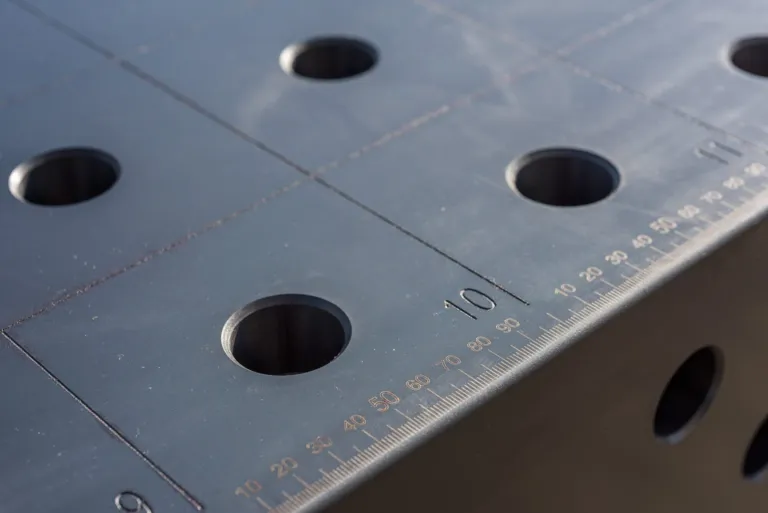
In short: Welding table is the umbrella term for a sturdy steel table for welding. Fixture table, welding fixture table, modular welding table and welding table with holes usually mean a table with system holes in a fixed grid; a 3D welding table has holes in the side walls too. Clamp table is broader and also appears in woodworking.
The terms around welding tables overlap heavily, and manufacturers and dealers use them in different ways. The table shows what is usually meant in a metalworking workshop.
| Term | Core feature | Hole grid |
|---|---|---|
| Welding table | umbrella term: sturdy steel table that serves as work surface and earth connection for welding | possible, not required |
| Welding table with holes | descriptive term: table top drilled for clamping tools | yes |
| Fixture table, welding fixture table | system holes at a fixed spacing, e.g. 100 x 100 mm, used with stops, squares and clamps | yes |
| Modular welding table | fixture table whose clamping tools and extensions form a reconfigurable system | yes |
| 3D welding table | holes in the top and side walls, clamping in three directions | yes, on the sides too |
| Welding jig table | base for building welding jigs, in practice usually a fixture table | usually yes |
| Clamp table | any table for clamping workpieces; also used for woodworking benches and machine tables | depends on design |
| Welding bench | synonym for welding table, or a workbench with a steel top | usually not, in the workbench sense |
| Assembly table | table for assembling, aligning and checking assemblies | depends on design |
A welding table is a sturdy steel work table on which components rest, are aligned and are fixed during welding. The steel top is heat-resistant, tolerates spatter and is usually part of the welding circuit via the earth clamp. Today, many people use the term specifically for a fixture table with a clamping system; more broadly, it covers any table with a solid steel top.
A welding table with holes is the plain, descriptive name for a welding table whose top is drilled throughout so that clamping tools can be inserted directly into the holes. The term says nothing about the diameter or spacing of the holes. In practice it almost always means a fixture table with system holes.
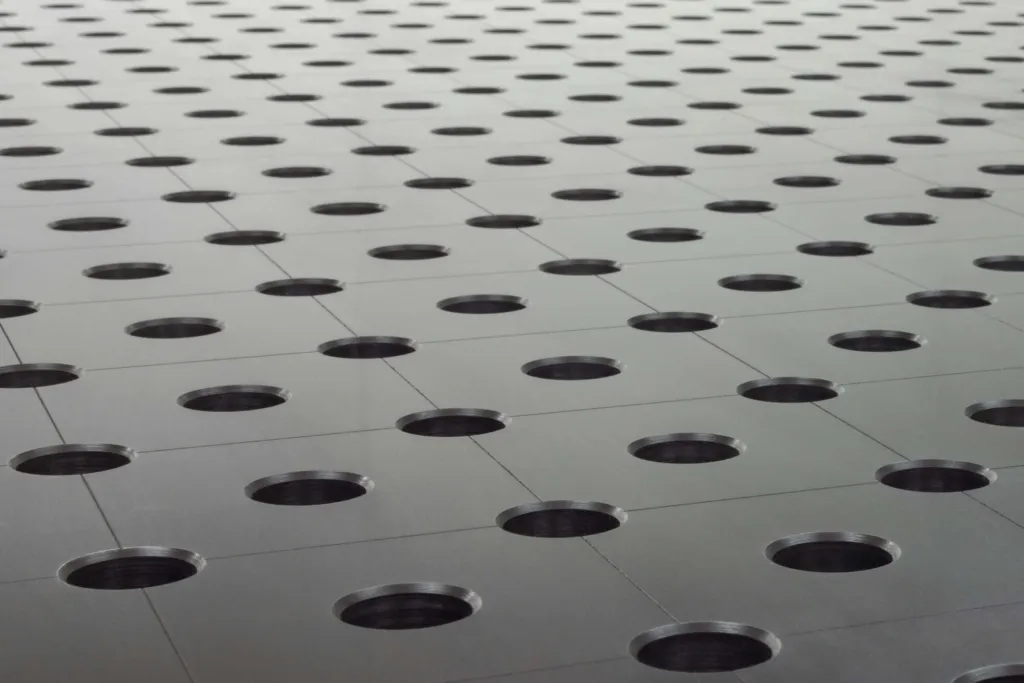
A fixture table, or welding fixture table, is a welding table with system holes at a fixed, even spacing, on which components are held in position by stops, clamping squares and clamps. The word fixture refers to this set-up of clamping tools that holds the parts, and the table is its base. The visible grid shows right angles of assemblies at a glance and allows stops to be positioned repeatably. On die schmiede tables, the hole diameter is 28 mm and the grid 100 x 100 mm from hole centre to hole centre.
A modular welding table is a fixture table whose top, clamping tools and extensions are designed as one system that can be reconfigured and extended. Stops, clamping squares and clamps fit into the same holes, and extension arms, construction bridges or a second table enlarge the work surface. The term describes the system idea rather than a separate type of table.
A 3D welding table has system holes not only in the top but also in the side walls, so that components can be clamped in all three spatial directions. Stops, angles, extension arms and construction bridges can be attached to the drilled side walls, and vertical constructions are possible without additional accessories. The tables from die schmiede have drilled side walls and are 3D welding tables in this sense.
A welding jig table is a table on which welding jigs are built, meaning set-ups that hold parts in the correct position for tacking and welding. In practice, the jig is assembled from stops, clamping squares and clamps on a fixture table, so welding jig table and welding fixture table often name the same product.
Clamp table is a broad term for any table on which workpieces are clamped, and its meaning depends on the trade. In welding it usually means a fixture table on which components are held with clamps and clamping bolts in the system holes. In woodworking, the same words describe workbenches and assembly tables with holes or rails for clamps and bench dogs, usually with a wooden or MDF top that is not designed for welding heat, spatter or as an earth connection. In machining, clamping tables with T-slots hold workpieces on machine tools, and the clamping elements slide continuously along the slots.
Welding bench is used in two ways. Some sellers use it as a plain synonym for welding table, and the term is also common in the UK. In its more specific sense, a welding bench is a workbench with a steel top for smaller welding, grinding and assembly jobs, often with a vice, drawers or a shelf and usually without a hole grid. It is practical for small parts and repairs, but lacks the clamping system needed for dimensionally accurate assemblies.
An assembly table is a work table for assembling, aligning and checking assemblies. A fixture table works well as an assembly table, because stops and clamping tools hold components in a defined position even when no welding is done at all.
A product name alone does not tell you whether a table suits your work or the accessories you already own. Whether a table is sold as a fixture table, a modular welding table or a 3D welding table, compare these figures:
The hole systems are compared in System 16 or System 28, and the full checklist for buying is in the buying guide.
A system hole is a hole with a defined diameter into which the clamping bolts and accessories of a particular system fit. The usual diameters are 16 mm and 28 mm, with some manufacturers also 22 mm. The systems are named after them: System 16, System 22 and System 28, or D16, D22 and D28. Accessories have system holes too; the universal stops from die schmiede, for example, have three or five.
The grid pitch is the distance between two neighbouring system holes, measured from centre to centre. In System 28, 100 mm is widespread, in System 16 often 50 mm. Diagonally drilled plates also have offset holes between the grid points and therefore offer more positions for clamping tools.
The side wall is the vertical edge running around the table top, which stiffens the table and is drilled as well on 3D welding tables. Its height determines which angles and bridges fit. On die schmiede tables, the side walls are 200 mm high.
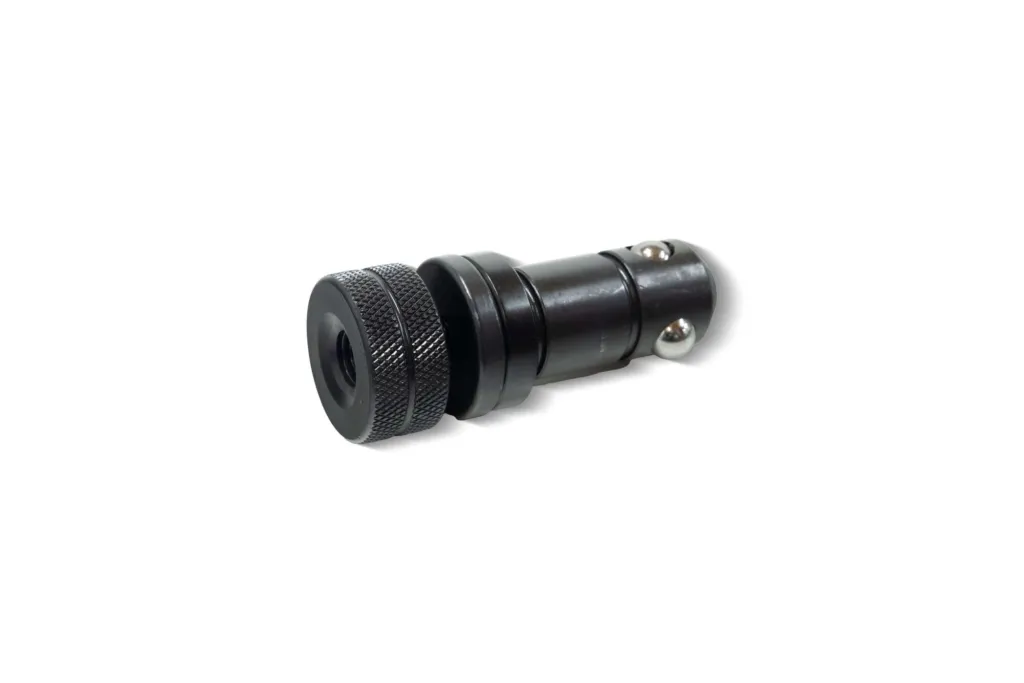
A quick-release clamping bolt connects two parts of the clamping system through the system holes and locks them against each other with locking balls, for example a stop to the table top. The quick-release clamping bolts from die schmiede have a black oxide finish, a diameter of 28 mm, a length of 95 mm and a twist lock. They are available for 15 mm and for 25 mm plate thickness. A variant is the magnetic clamping bolt, which clamps without tools.
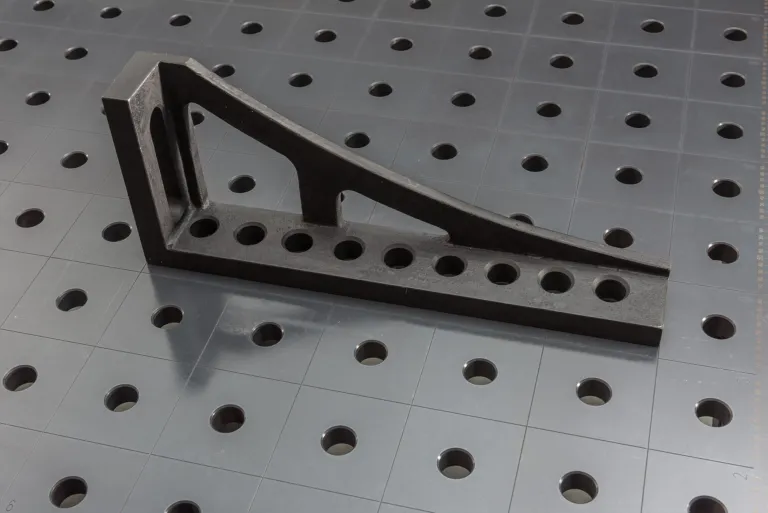
A stop is a clamping tool against which a workpiece rests, so that it lies in a defined position and at the right angle. Stops are fixed in the system holes with clamping bolts. They come as universal stops, flat angles, eccentric stops or combined as stop and clamping squares, many of them with a millimetre scale.
A clamping square, also called a stop and clamping square, is an angled element with system holes that serves as a stop and to which clamps and other clamping tools can be attached. With it you set up components at right angles or clamp vertically. An overview is on Stops and clamping squares.
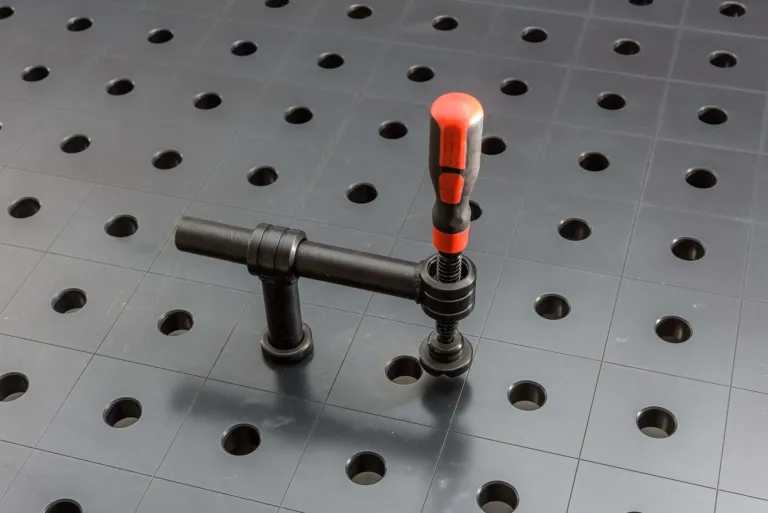
A screw clamp for fixture tables is inserted into a system hole by its shaft and uses a spindle to press the workpiece onto the table top or against a stop. Together with clamping bolts and stops, such welding clamps are part of the basic equipment of a fixture table. The professional screw clamps from die schmiede are available in 90° and 45° versions. More on Clamps and clamping bolts.
A V-block, also called a prism, is a clamping tool with a V-shaped seat in which round parts such as tubes and shafts rest securely and centred. Several V-blocks are available from die schmiede, including a Vario V-block for 90° and 120°.
A construction bridge is a drilled section that is attached to the side wall and serves as an additional clamping and support surface. According to die schmiede, it joins two welding tables into one large work surface or serves as a vertical construction and clamping aid. Matching parts are listed under Extensions and construction bridges.
Plasma nitriding is a surface hardening process in which nitrogen diffuses into the steel surface and makes it harder and more wear-resistant. What this means for a welding table is explained in Plasma nitriding explained.
System 28 welding tables with drilled side walls and the matching accessories, made by die schmiede in Marktsteft, Germany. Request a quote for your country; the online shop is in German and delivers within Germany only.
A fixture table is a type of welding table, but not every welding table is a fixture table. Welding table is the umbrella term for any sturdy steel table used for welding, including tables with a plain top. A fixture table has system holes in a fixed grid in which clamping tools are fixed, so parts can be positioned repeatably. In everyday sales language, both terms are often used for the same product.
Not always. In welding, clamp table usually means a fixture table on which workpieces are clamped through the system holes. The same words are also used for woodworking benches with holes or rails for clamps and for machine clamping tables with T-slots. A woodworking clamp table is not designed for welding heat, spatter or as an earth connection, so check the material and intended use before buying.
Often, yes: both terms describe a welding table with system holes in a fixed grid on which clamping tools are fixed. Modular emphasises that table, clamping tools and extensions form a system that can be reconfigured and extended. Before buying, compare hole diameter, grid pitch, plate thickness and side wall height rather than the product name, because these figures determine which accessories fit.
The name 3D welding table refers to the fact that components can be clamped in all three spatial directions. This is made possible by system holes not only in the table top but also in the side walls. Stops, angles and bridges can be attached there, so that vertical and laterally projecting set-ups are also held firmly and accurately.
In machining, a jig traditionally guides the cutting tool, while a fixture only holds the workpiece in position. In welding, the two words are largely used interchangeably for set-ups that hold parts in the correct position for tacking and welding. A welding jig table or welding fixture table is the base on which such set-ups are built from stops, clamping squares and clamps.
It depends on who uses the term. Some sellers use welding bench as a plain synonym for welding table. In its more specific sense, a welding bench is a workbench with a steel top for smaller welding, grinding and assembly jobs, often with a vice or shelf and without a hole grid. For dimensionally accurate assemblies, a fixture table with a clamping system is the more suitable choice.
A 28 mm or 16 mm welding table differs in the diameter of its holes and therefore in …
Welding table squares and stops set the reference edges on the table: universal stops in the plane, angle …
Welding table clamps press the workpiece onto the table, quick-release clamping bolts connect stops and squares to the …
5.012 reviews on Google
Ich kam mit einem kleinen außergewöhnlichen Anliegen und freue mich über so viel spontane Hilfe, Freundlichkeit und Professionalität, DANKE!
Tanja B.View on Google: review by Tanja B. (opens in a new tab)
Nicht mehr daran geglaubt - aber es gibt sie noch ! Deutsche Wertarbeit !! Rechtzeitig zum Frühlingsanfang konnten wir unsere "Wasserdichte Balkonanlage" mit Außentreppe einweihen und sind vollends begeistert von der…
Hubert L.View on Google: review by Hubert L. (opens in a new tab)
Eine Super-Schmiede, die auch Außergewöhnliche Produkte kreieren kann. Meine Kreuz, die ich zur Entstörung von Elektrosmog wurden auf Millimeter genaue Einstellung geschmiedet. Das war eine Klasseleistung! Jetzt kann ich wieder…
GoggoschelleView on Google: review by Goggoschelle (opens in a new tab)
Unsere verbogene Garagentorstange wurde sehr kurzfristig gerade gerichtet. Nettes Team. Gerne wieder.
knecht116View on Google: review by knecht116 (opens in a new tab)
Sehr kompetente Beratung ohne etwas verkaufen zu wollen! In Zukunft erste Anlaufstelle!
Wir haben im Januar einen Balkon mit Geländer und Treppe zum Garten erhalten und sind mit der Arbeit von "Die Schmiede" vollstens zufrieden. Die gesamte Abwicklung von Planung bis Montage hat problemlos geklappt. Wir können Herrn…
Daniela L.View on Google: review by Daniela L. (opens in a new tab)
Top Firma, zuverlässig, fair, preiswert, spitze Arbeit… immer wieder gerne!
Dieter H.View on Google: review by Dieter H. (opens in a new tab)
Wann immer ich Hilfe bei der Reparatur von Gartendekorationen aus Metall benötigte, wandte ich mich immer an die Schmiede. Warum? denn die Mitarbeiter sind sehr hilfsbereit und immer hilfsbereit bei Metallarbeiten. Hier sind Sie…
Super freundlich und die Schweißtische haben eine Top Qualität. Weiter so !
Michael M.View on Google: review by Michael M. (opens in a new tab)
Super höfliche Fachkräfte die tolle Arbeit geleistet haben in kurzer Zeit. Der Chef war vor Arbeitsbeginn persönlich vor Ort und jederzeit erreichbar! Qualität zu einem defitnitv fairen Preis. Top Firma! Wir sind mit unserem Zaun…
Damla K.View on Google: review by Damla K. (opens in a new tab)
Wir haben vor einem Jahr ein neues Balkongeländer von "Die Schmiede" erhalten. Alles war super, der Chef persönlich hat Maß genommen und nach nur 4 Wochen erfolgte direkt die Montage. Das alles zu einem Super Preis und man hat…
Philipp B.View on Google: review by Philipp B. (opens in a new tab)
Reviews are shown in their original language (German). This is a selection of the most recent Google reviews with 4 or 5 stars and a written comment (up to 12). Reviews have not been checked for authenticity.