
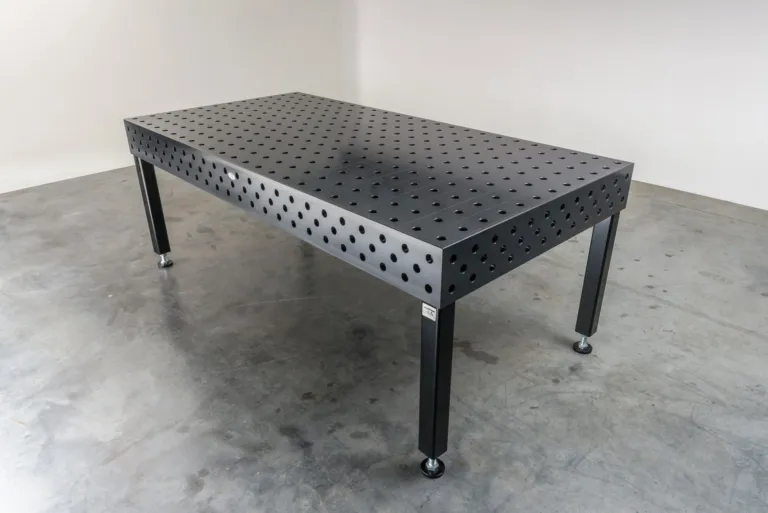
PRO welding table 25 mm
The PRO welding table has a 25 mm welding table top in S355J2+N, plasma nitrided and surface ground, …
Guide: surface treatment
A plasma nitrided welding table has a hardened surface layer that reduces wear, rust and sticking weld spatter. Here you can read how the process works, where its limits are and how it compares with stainless steel.
Last updated
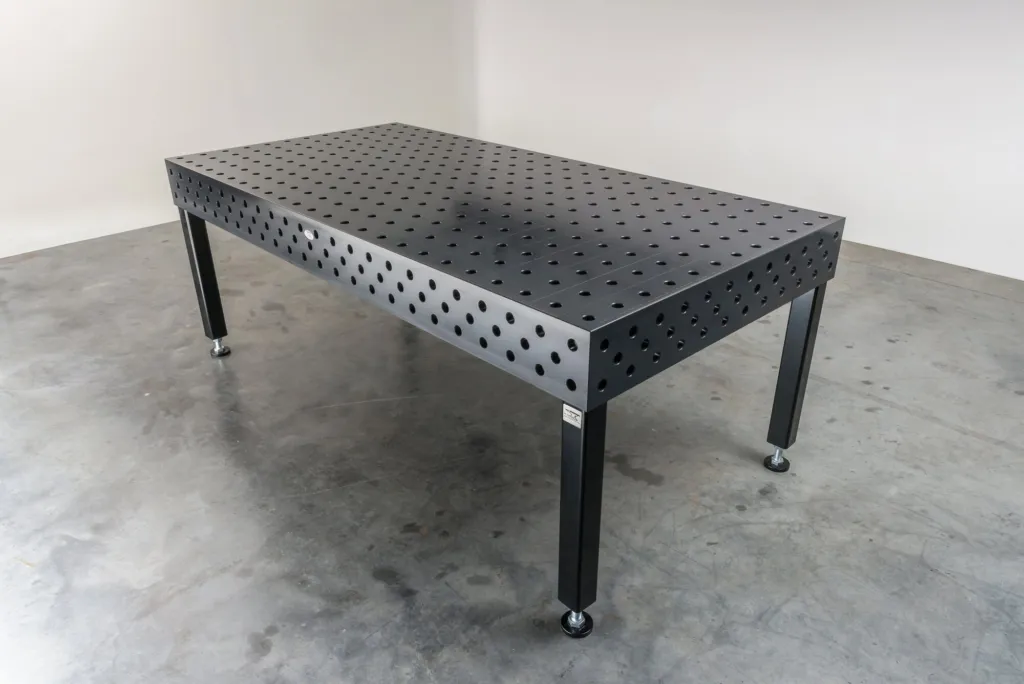
In short: Plasma nitriding is a heat treatment in which nitrogen diffuses into the surface of the steel. The surface layer becomes considerably harder and more wear-resistant, weld spatter adheres less, and corrosion protection improves. It does not make the table rustproof. Colour differences on nitrided surfaces are caused by the material and are normal.
Plasma nitriding is a thermochemical surface hardening process in which nitrogen from an ionised gas diffuses into the surface of steel. The component sits in a vacuum chamber and is connected as the cathode. An electrical glow discharge ionises a gas mixture of nitrogen and hydrogen. The ions strike the surface, clean it and release nitrogen into the steel.
The process typically runs at approx. 400 to 600 °C, below the temperature at which the microstructure of structural steel transforms, and without quenching. That is why plasma nitriding is regarded as low-distortion. Other names are ion nitriding and glow discharge nitriding. Important in practice: nitriding is not a coating that can flake off, it changes the surface layer of the steel itself.
A nitrided surface layer consists of a thin, very hard compound layer at the surface and a diffusion zone beneath it. The compound layer of iron nitrides is only a few micrometres thick and provides a large part of the protection against wear and corrosion. Depending on material and treatment time, the diffusion zone usually reaches a few tenths of a millimetre deep and supports the hard surface.
The core of the steel stays tough and unchanged. For care, this leads to a clear rule: whatever is removed with a grinding disc or flap disc is no longer nitrided at that point. How to remove spatter gently is described in the guide Care and cleaning.
Plasma nitriding, gas nitriding and salt bath nitriding all produce a nitrided surface layer, but they differ in the medium that supplies the nitrogen. In gas nitriding it comes from a furnace atmosphere containing ammonia, in salt bath nitriding from molten salts containing nitrogen, often combined with carbon as nitrocarburising. In plasma nitriding it is supplied by ionised gas in a vacuum.
The plasma process is regarded as easy to control: temperature, gas composition and treatment time can be set precisely, and the ion bombardment cleans the surface during treatment. Areas that should stay soft can be masked, and no salt baths are involved. For the user at the welding table, what counts in the end is the result: a hard, wear-resistant surface layer on a flat top.
On a welding table, plasma nitriding brings four practical benefits: higher surface hardness, less wear, better corrosion protection and less weld spatter sticking to the top.
Dimensional stability is a further benefit: because nitriding involves no quenching, the plate stays largely as flat as it was machined beforehand.
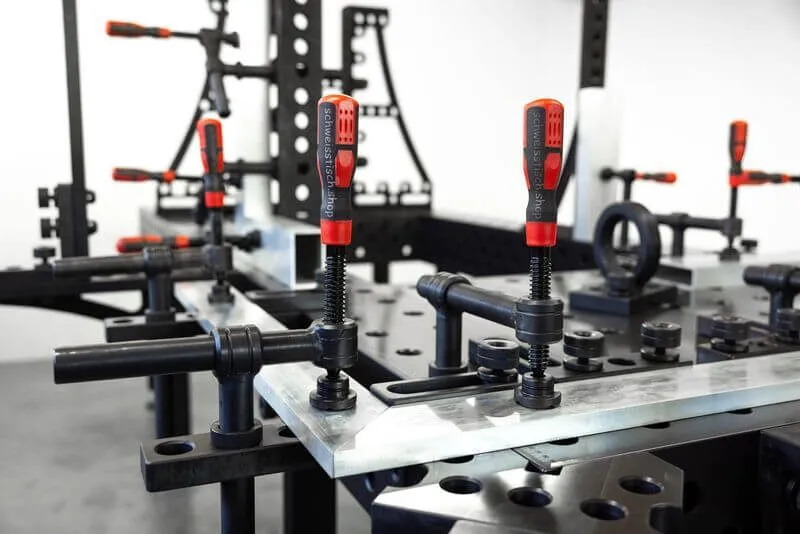
Colour differences, clouding or patches on a plasma nitrided welding table are caused by the material and are normal for nitrided surfaces. They arise, for example, from small differences in the material, in the previous machining of the surface and in temperature distribution during treatment. The manufacturer die schmiede explicitly points out that the material can cause discolouration on the surfaces of its tables.
In use, the appearance keeps changing: welding heat produces temper colours, and anti-spatter agents and cleaners leave marks. These changes affect the look. What matters for function is flatness, clean holes and an intact surface layer.
For welding steel, a nitrided surface offers the most practical benefits, while a stainless steel table makes sense for processing stainless steel. The table shows the differences in qualitative terms.
| Property | Plasma nitrided steel | Untreated steel | Stainless steel, e.g. 1.4301 |
|---|---|---|---|
| Surface hardness | high, around 850 HV on die schmiede PRO tables | hardness of the base material | not hardened, comparatively soft |
| Wear | low | higher, scratches and dents appear sooner | higher than nitrided steel |
| Weld spatter | adheres poorly, anti-spatter agent recommended | bonds more easily with the surface | anti-spatter agent recommended |
| Rust | better protected than bare steel, flash rust possible | rusts quickly without care | corrosion-resistant |
| Contamination rust on stainless parts | possible | possible | avoided |
| Typical use | general steel fabrication, metalwork | simple welding stations, DIY builds | processing stainless steel |
Contamination rust occurs when iron particles from steel tools or a steel base transfer to stainless steel parts and rust there. If you regularly weld stainless steel, you therefore keep tools and work surfaces separate.
For this, die schmiede offers a stainless steel welding table in 1.4301. For this table the shop states no nitriding but a non-stick coated surface.
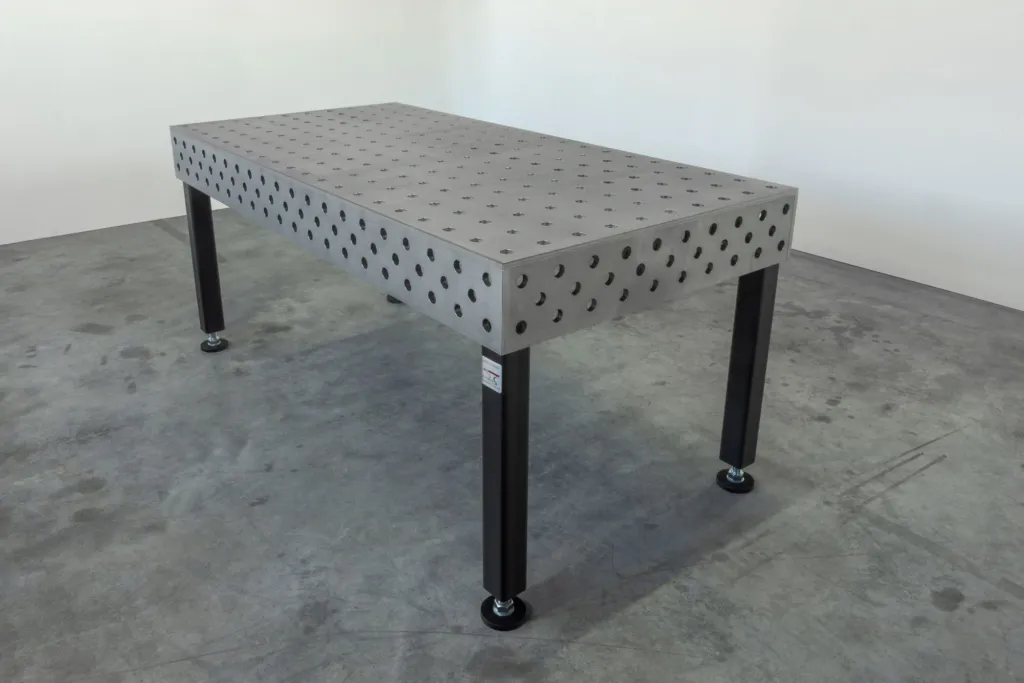
A nitrided welding table needs little care, but it does not tolerate a grinding disc on the work surface. Three rules are enough for everyday work:
Detailed advice on cleaning, flash rust and holes is in the guide Welding table care and cleaning.
According to the shop, both the PRO tables with 25 mm and the Standard tables with 15 mm from die schmiede are plasma nitrided. The differences lie in the material and the finishing of the surface.
| Version | Material | Surface |
|---|---|---|
| Standard, 15 mm | S355MC, micro-alloyed fine-grain steel | non-stick coated, plasma nitrided |
| PRO, 25 mm | S355J2+N | plasma nitrided, surface ground, around 850 HV, holes countersunk by 3 mm |
| Stainless steel, 15 mm | 1.4301 | non-stick coated, no nitriding stated |
| Accessories | stops, squares, clamps, V-blocks | nitrided, quick-release clamping bolts with black oxide finish |
More on the two lines: PRO welding table 25 mm and Standard welding table 15 mm.
PRO tables with a 25 mm, surface-ground and plasma nitrided top in System 28 with a 100 mm grid. Request a quote for your project, or see the PRO range in the online shop, which is in German and delivers within Germany only.
No, a plasma nitrided welding table is not rustproof. The nitrided layer improves corrosion protection compared with bare steel, but moisture, condensation or sweat from hands can still cause flash rust. Keep the table dry, remove flash rust early and protect the surface with a thin film of oil when it stands unused for longer periods.
Grinding large areas makes no sense, because the hardened surface layer only reaches a few tenths of a millimetre deep and is lost wherever material is removed. What remains is softer steel that wears and rusts faster. Stubborn spatter is better removed with a scraper or a honing stone held flat. Discuss deep damage with the manufacturer.
HV stands for Vickers hardness. In this test, a diamond pyramid is pressed into the surface with a defined force and the indentation is measured. The higher the value, the harder the surface. For its PRO tables, die schmiede states around 850 HV. Values from different manufacturers are only comparable if the test load and measuring method are known.
In principle, yes: heat treatment shops offer plasma nitriding as a subcontract service, provided the plate fits into the furnace. Spatter, rust, oil and paint must be removed completely beforehand. Existing distortion or damage remains, because nitriding only hardens the existing surface. Clarify size, weight and effort with the heat treatment shop in advance.
Plasma nitriding changes the dimensions only very slightly, because it works without quenching and at a comparatively low temperature. The uptake of nitrogen can make the surface grow minimally, and residual stresses in the material can have a slight effect. That is why the plate is usually machined to its final state before nitriding, so that holes and flatness are right afterwards.
The PRO welding table has a 25 mm welding table top in S355J2+N, plasma nitrided and surface ground, …
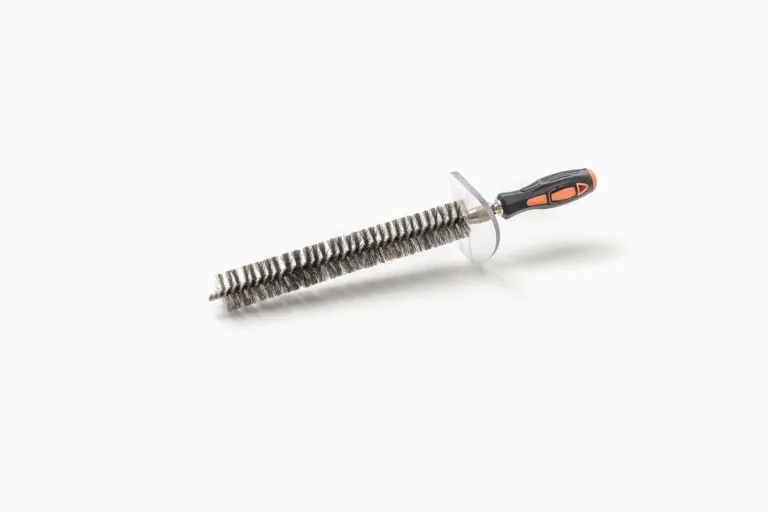
A welding table stays accurate when its top and holes are clean and dry. Here you can read …
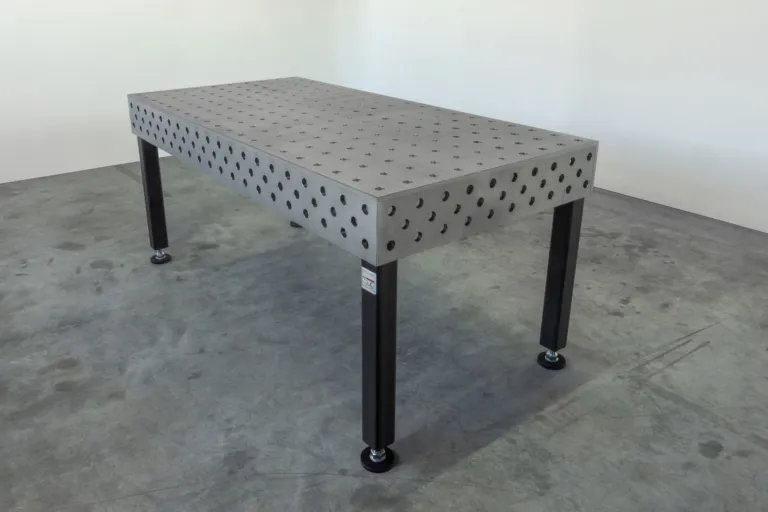
The stainless steel welding table from die schmiede has a 15 mm plate in stainless steel 1.4301 with …
5.012 reviews on Google
Ich kam mit einem kleinen außergewöhnlichen Anliegen und freue mich über so viel spontane Hilfe, Freundlichkeit und Professionalität, DANKE!
Tanja B.View on Google: review by Tanja B. (opens in a new tab)
Nicht mehr daran geglaubt - aber es gibt sie noch ! Deutsche Wertarbeit !! Rechtzeitig zum Frühlingsanfang konnten wir unsere "Wasserdichte Balkonanlage" mit Außentreppe einweihen und sind vollends begeistert von der…
Hubert L.View on Google: review by Hubert L. (opens in a new tab)
Eine Super-Schmiede, die auch Außergewöhnliche Produkte kreieren kann. Meine Kreuz, die ich zur Entstörung von Elektrosmog wurden auf Millimeter genaue Einstellung geschmiedet. Das war eine Klasseleistung! Jetzt kann ich wieder…
GoggoschelleView on Google: review by Goggoschelle (opens in a new tab)
Unsere verbogene Garagentorstange wurde sehr kurzfristig gerade gerichtet. Nettes Team. Gerne wieder.
knecht116View on Google: review by knecht116 (opens in a new tab)
Sehr kompetente Beratung ohne etwas verkaufen zu wollen! In Zukunft erste Anlaufstelle!
Wir haben im Januar einen Balkon mit Geländer und Treppe zum Garten erhalten und sind mit der Arbeit von "Die Schmiede" vollstens zufrieden. Die gesamte Abwicklung von Planung bis Montage hat problemlos geklappt. Wir können Herrn…
Daniela L.View on Google: review by Daniela L. (opens in a new tab)
Top Firma, zuverlässig, fair, preiswert, spitze Arbeit… immer wieder gerne!
Dieter H.View on Google: review by Dieter H. (opens in a new tab)
Wann immer ich Hilfe bei der Reparatur von Gartendekorationen aus Metall benötigte, wandte ich mich immer an die Schmiede. Warum? denn die Mitarbeiter sind sehr hilfsbereit und immer hilfsbereit bei Metallarbeiten. Hier sind Sie…
Super freundlich und die Schweißtische haben eine Top Qualität. Weiter so !
Michael M.View on Google: review by Michael M. (opens in a new tab)
Super höfliche Fachkräfte die tolle Arbeit geleistet haben in kurzer Zeit. Der Chef war vor Arbeitsbeginn persönlich vor Ort und jederzeit erreichbar! Qualität zu einem defitnitv fairen Preis. Top Firma! Wir sind mit unserem Zaun…
Damla K.View on Google: review by Damla K. (opens in a new tab)
Wir haben vor einem Jahr ein neues Balkongeländer von "Die Schmiede" erhalten. Alles war super, der Chef persönlich hat Maß genommen und nach nur 4 Wochen erfolgte direkt die Montage. Das alles zu einem Super Preis und man hat…
Philipp B.View on Google: review by Philipp B. (opens in a new tab)
Reviews are shown in their original language (German). This is a selection of the most recent Google reviews with 4 or 5 stars and a written comment (up to 12). Reviews have not been checked for authenticity.