
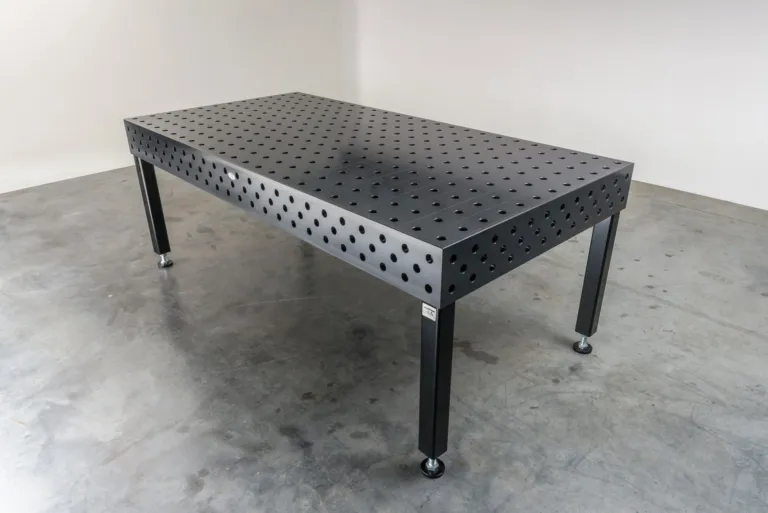
Plasma nitriding explained
A plasma nitrided welding table has a hardened surface layer that reduces wear, rust and sticking weld spatter. …
Guide: care
A welding table stays accurate when its top and holes are clean and dry. Here you can read how to remove spatter gently, use anti-spatter spray correctly, prevent welding table rust and which mistakes damage the surface.
Last updated
In short: Keep the welding table clean and dry, apply a thin coat of anti-spatter spray before welding and remove spatter with a scraper or honing stone rather than an angle grinder. Clean the holes with a hole brush. Remove flash rust early and then protect the surface with a thin film of oil.
Care keeps the work surface flat and the holes clean, and the accuracy of your components depends directly on both. A single burnt-on spatter under a profile lifts it and distorts angles and dimensions. Slag in a hole prevents a quick-release clamping bolt from locking fully. Rust roughens the surface and attacks it over time.
The effort is manageable: a few minutes after work, anti-spatter spray before welding and a regular look at the holes are usually enough.
A short clean after every working day prevents spatter from burning on and dirt from getting into the holes.
Take workpieces, offcuts and clamping tools off the table. Remove slag, chips and dust with a hand brush or an industrial vacuum cleaner.
Push off loose weld spatter with a spatula or scraper held flat, without digging the edge into the surface.
Brush dirty holes through with a suitable hole brush so that bolts and stops sit cleanly again.
For grease, oil or dirt, spray on a cleaner, leave it to act briefly and wipe it off with a clean cloth.
Let the surface dry completely. Before longer breaks, apply a thin film of oil.
According to the shop, the welding table cleaner from die schmiede is a bio-based cleaner with high dissolving power for grease and dirt. It comes in a 500 ml bottle with a spray head.
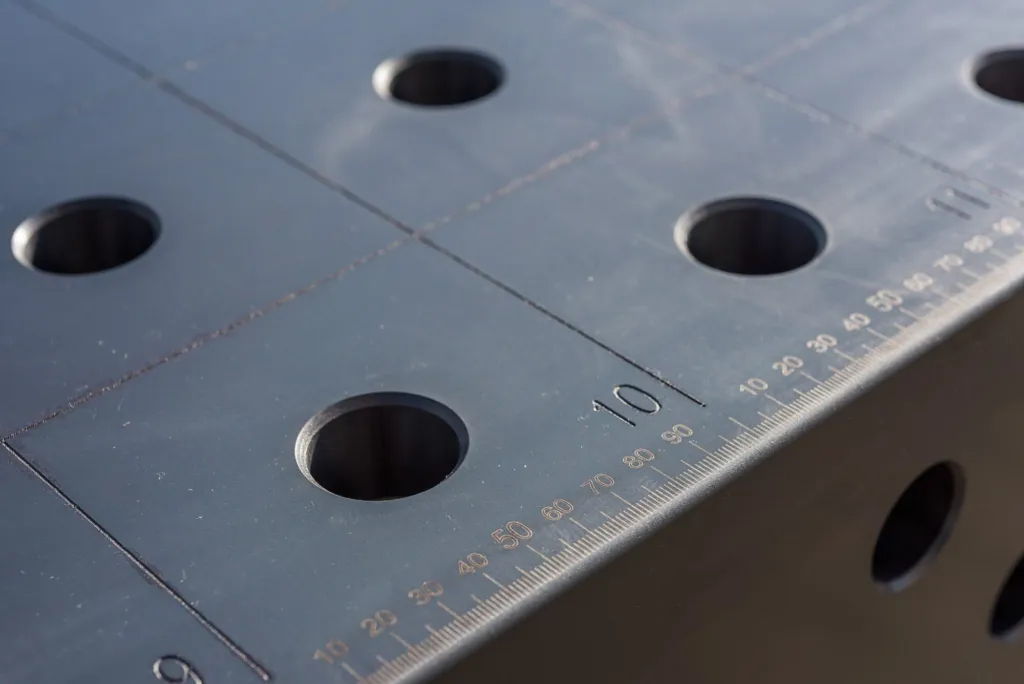
On a nitrided table, remove weld spatter mechanically with a scraper or honing stone, which is far gentler on the surface than an angle grinder. On a hard, nitrided surface like that of the welding tables from die schmiede, spatter adheres poorly and can usually be pushed off with a spatula held flat. Work stubborn residue off with a flat honing stone in circular movements until the surface is smooth again.
Grinding discs, flap discs and cutting discs do not belong on the work surface. They remove the nitrided layer, which is only a few tenths of a millimetre thick, and leave hollows in which rust and new spatter take hold. Why the surface layer is so thin is explained in Plasma nitriding explained.
Anti-spatter spray forms a thin film on which weld spatter cannot burn on, which saves cleaning time on the table, clamping tools and workpiece. For its nitrided tables, too, die schmiede explicitly recommends anti-spatter agents, even though weld residue is easy to remove from them.
According to the shop, the anti-spatter lotion from die schmiede is made on a natural, bio-based formula, comes in a 500 ml bottle with a spray head and protects welding tables, tools, jigs and nozzles against weld spatter.
Flash rust on steel welding tables is caused mainly by moisture, condensation, sweat from hands and grinding sparks. Even a plasma nitrided table is not rustproof, it just rusts more slowly than bare steel. Condensation forms when warm, humid air meets the cold steel plate, for example when a cold workshop is heated up in the morning.
How to prevent it:
Remove light flash rust early with a cleaner and a fine abrasive fleece, used flat and without pressure. Then clean, dry and lightly oil the surface. Deep rust pitting cannot be removed without taking off material. Discuss larger damage with the manufacturer before you reach for a grinder.
Clean holes are the precondition for quick-release clamping bolts to lock fully and for stops to sit exactly. Spatter and slag fall into the holes during welding and stick to the edges. Even small residues can make a bolt jam.
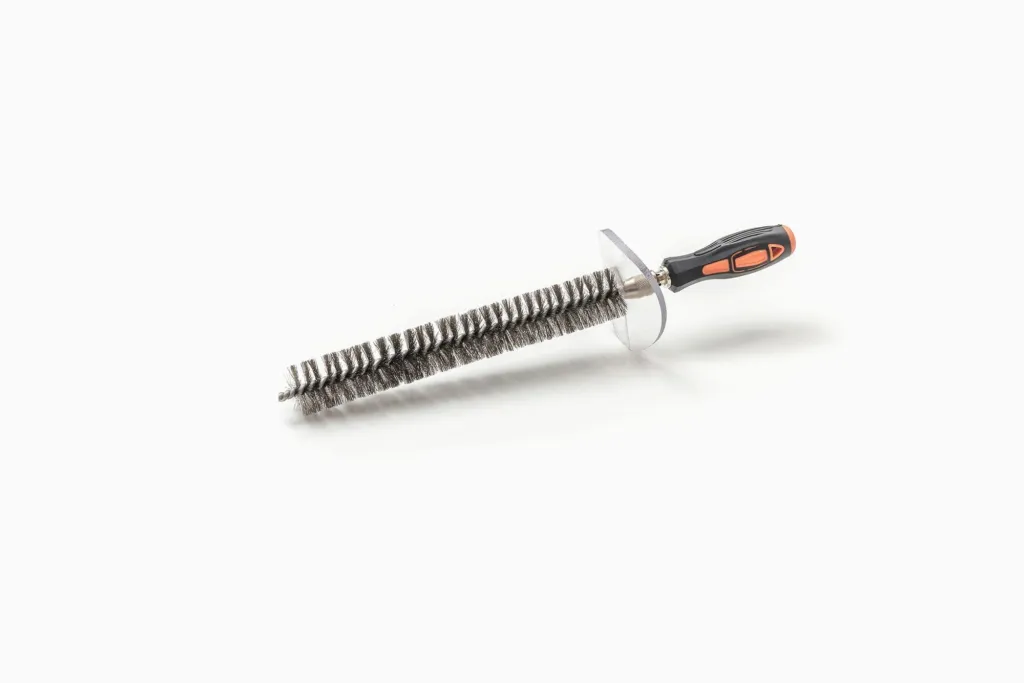
For 28 mm holes, die schmiede offers a hole brush with a diameter of 30 mm, designed specifically for cleaning 28 mm holes. Brush the hole through from the top and then vacuum up the loosened particles.
Look after the bolts as well: the quick-release clamping bolts from die schmiede have a black oxide finish. Black oxide offers only limited protection against rust, so store bolts clean and lightly oiled. Check at the same time that the locking balls move freely.
Clamping tools stay accurate when they are stored clean, lightly oiled and in order, rather than lying loose on the table top. Clamps and squares put down loosely scratch the surface and go missing in everyday workshop life. An accessory trolley keeps clamping tools within reach next to the table; die schmiede lists one among its accessories.
If the table stands unused for a longer period, clean it thoroughly, oil it lightly and cover it with a breathable sheet. Airtight plastic sheeting is unsuitable, because condensation collects underneath. A dry room with an even temperature is ideal.
Much of the damage to welding tables can be avoided with a few rules. These mistakes cost flatness, surface quality or accuracy:
On a stainless steel welding table, the main issue is not rust but avoiding contamination rust from iron particles. On the table, use only brushes, scrapers and abrasives that have not been used on carbon steel before, ideally dedicated tools for stainless steel only. Do not grind or cut carbon steel near the table, because sparks and dust leave iron particles behind. More on the table in 1.4301 is on Stainless steel welding table.
Welding table cleaner, anti-spatter lotion and hole brush from die schmiede are listed among the accessories in the online shop, which is in German and delivers within Germany only. For orders from other countries, request a quote.
Clean a welding table mechanically and with a degreasing cleaner. Push off spatter with a spatula or scraper, clean the holes with a hole brush, and remove grease and dirt with a cleaner and a clean cloth. Avoid angle grinders, acids and chlorine-based products, and let the surface dry thoroughly afterwards.
Yes, a thin film of acid-free oil protects the steel surface against flash rust, especially when the table stands unused for longer periods or in cold workshops. Apply the oil sparingly and wipe off the excess. Before welding, the surface in the work area should be free of oil, because oil smokes under heat and can carry contamination into the weld.
Yes, die schmiede recommends anti-spatter spray for its plasma nitrided tables too, even though weld residue is easy to remove from them. The thin film stops spatter from burning on, so cleaning takes less time on the table, the clamping tools and the workpiece. Apply it thinly around the weld area and keep it out of the weld joint.
Apply anti-spatter spray around the weld area before every welding job, meaning on the table and clamping tools within the spatter zone. During longer jobs, reapply as soon as spatter starts to stick again. A thin, even film is enough. Make sure no anti-spatter agent gets into the weld joint, because residue in the seam can cause porosity.
Yes, light flash rust can be removed without significantly attacking the nitrided layer. Use a cleaner and a fine abrasive fleece, held flat and without pressure. Coarse abrasives and angle grinders, by contrast, remove the hard surface layer. Afterwards, clean, dry and lightly oil the surface so that the rust does not come straight back.
If a quick-release clamping bolt jams, the cause is often spatter, slag or rust in the hole or on the locking balls. Release the bolt without force, clean the hole with a hole brush and the bolt with a cleaner, and oil it lightly. Never drive bolts in with a hammer, as this damages the bolt and the edge of the hole.
A plasma nitrided welding table has a hardened surface layer that reduces wear, rust and sticking weld spatter. …
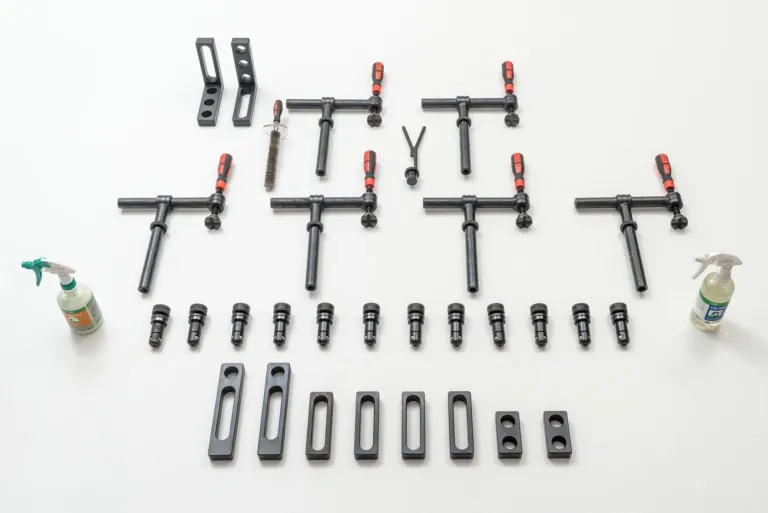
Accessories from die schmiede fit directly into the 28 mm holes of the 100 mm grid: stops and …
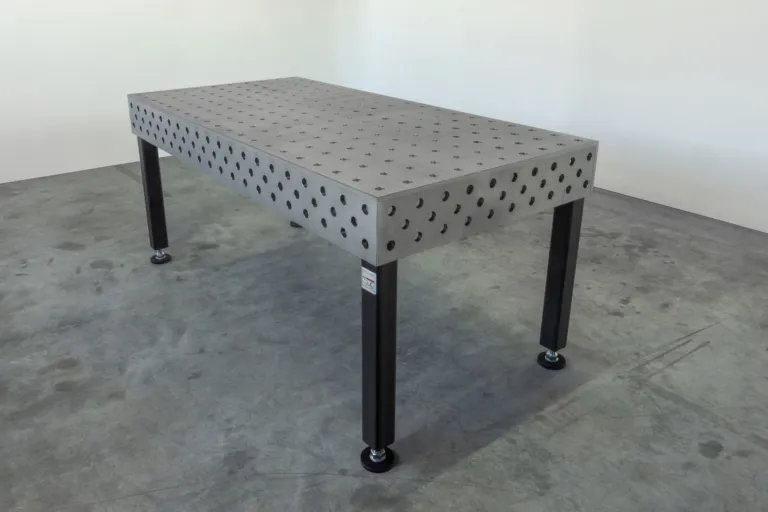
The stainless steel welding table from die schmiede has a 15 mm plate in stainless steel 1.4301 with …
5.012 reviews on Google
Ich kam mit einem kleinen außergewöhnlichen Anliegen und freue mich über so viel spontane Hilfe, Freundlichkeit und Professionalität, DANKE!
Tanja B.View on Google: review by Tanja B. (opens in a new tab)
Nicht mehr daran geglaubt - aber es gibt sie noch ! Deutsche Wertarbeit !! Rechtzeitig zum Frühlingsanfang konnten wir unsere "Wasserdichte Balkonanlage" mit Außentreppe einweihen und sind vollends begeistert von der…
Hubert L.View on Google: review by Hubert L. (opens in a new tab)
Eine Super-Schmiede, die auch Außergewöhnliche Produkte kreieren kann. Meine Kreuz, die ich zur Entstörung von Elektrosmog wurden auf Millimeter genaue Einstellung geschmiedet. Das war eine Klasseleistung! Jetzt kann ich wieder…
GoggoschelleView on Google: review by Goggoschelle (opens in a new tab)
Unsere verbogene Garagentorstange wurde sehr kurzfristig gerade gerichtet. Nettes Team. Gerne wieder.
knecht116View on Google: review by knecht116 (opens in a new tab)
Sehr kompetente Beratung ohne etwas verkaufen zu wollen! In Zukunft erste Anlaufstelle!
Wir haben im Januar einen Balkon mit Geländer und Treppe zum Garten erhalten und sind mit der Arbeit von "Die Schmiede" vollstens zufrieden. Die gesamte Abwicklung von Planung bis Montage hat problemlos geklappt. Wir können Herrn…
Daniela L.View on Google: review by Daniela L. (opens in a new tab)
Top Firma, zuverlässig, fair, preiswert, spitze Arbeit… immer wieder gerne!
Dieter H.View on Google: review by Dieter H. (opens in a new tab)
Wann immer ich Hilfe bei der Reparatur von Gartendekorationen aus Metall benötigte, wandte ich mich immer an die Schmiede. Warum? denn die Mitarbeiter sind sehr hilfsbereit und immer hilfsbereit bei Metallarbeiten. Hier sind Sie…
Super freundlich und die Schweißtische haben eine Top Qualität. Weiter so !
Michael M.View on Google: review by Michael M. (opens in a new tab)
Super höfliche Fachkräfte die tolle Arbeit geleistet haben in kurzer Zeit. Der Chef war vor Arbeitsbeginn persönlich vor Ort und jederzeit erreichbar! Qualität zu einem defitnitv fairen Preis. Top Firma! Wir sind mit unserem Zaun…
Damla K.View on Google: review by Damla K. (opens in a new tab)
Wir haben vor einem Jahr ein neues Balkongeländer von "Die Schmiede" erhalten. Alles war super, der Chef persönlich hat Maß genommen und nach nur 4 Wochen erfolgte direkt die Montage. Das alles zu einem Super Preis und man hat…
Philipp B.View on Google: review by Philipp B. (opens in a new tab)
Reviews are shown in their original language (German). This is a selection of the most recent Google reviews with 4 or 5 stars and a written comment (up to 12). Reviews have not been checked for authenticity.