
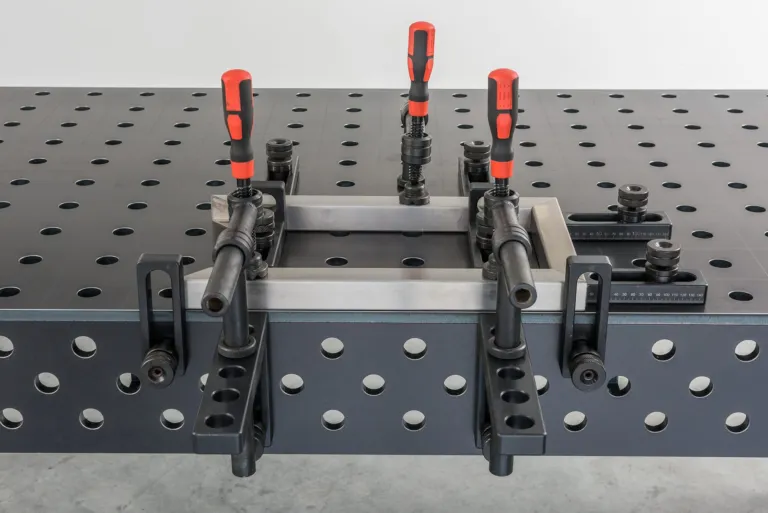
Buying a welding table
When buying a welding table, plate thickness, format and hole system matter most, followed by surface, weight, working …
Guide: DIY build
A simple DIY welding table is well within reach for an experienced welder, while an accurate fixture table with a hole grid takes a lot of effort. Here you can read what matters for flatness, hole pattern, material and accessories, and when buying pays off.
Last updated
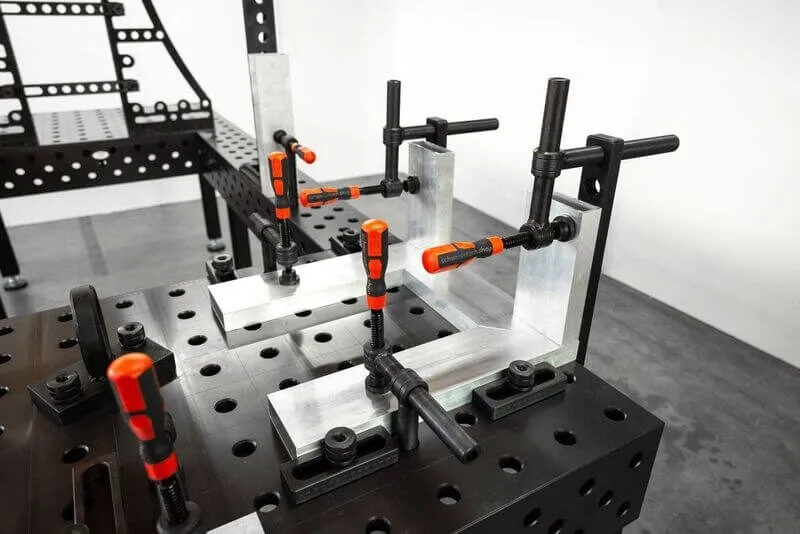
In short: Experienced welders can build a simple welding table from a steel plate and a frame themselves. A fixture table with a hole grid is far more demanding: flatness, distortion during welding and an accurate hole pattern for clamping bolts call for machines that many workshops lack. Weigh material, time and rework honestly against a bought table.
Whether a DIY build pays off depends less on the welding than on flatness, hole pattern and the time you can invest. The table shows the key differences between a self-built and a bought fixture table.
| Criterion | DIY build | Bought fixture table |
|---|---|---|
| Flatness | depends on plate, welding sequence and straightening, hard to achieve without machining the surface | machined by the manufacturer, surface ground on the PRO tables from die schmiede |
| Hole pattern | magnetic drill or subcontract work, position and size errors are possible | usually machine drilled, even grid |
| Surface | usually untreated, nitriding only as subcontract work | plasma nitrided or stainless steel |
| Accessories | only fit with exact holes and a suitable plate thickness | system accessories fit without adjustment |
| Time | many working hours for cutting, welding, drilling and straightening | fit the feet, set the height |
| Costs | material, tools, subcontract work and your own working time | purchase price plus delivery |
| Learning effect | high | low |
A DIY build is worth it mainly for a simple welding table without a hole grid, for a welding bench for small parts or if you deliberately see the project as practice. If you can weld and have plate, sections and tools available in your business, you can build a solid work table with reasonable effort. For tacking, grinding and small repairs, a table like this is perfectly adequate.
In training, too, building your own table is a good exercise: cutting, tacking sequence, distortion control and measuring all come together in one project. It only gets difficult when the table is supposed to offer the accuracy and system accessories of a fixture table.
When you build a welding table yourself, distortion is the central technical hurdle: every weld shrinks as it cools and pulls the plate in its direction. When side walls, reinforcements and frame are welded to the plate, these forces add up. On top of that come residual stresses from rolling and thermal cutting, which are released when the plate is heated.
How to keep distortion low:
After welding, a truly flat surface can usually only be achieved by face milling or surface grinding. That requires a machine large enough for the table, which makes it a costly job to subcontract.
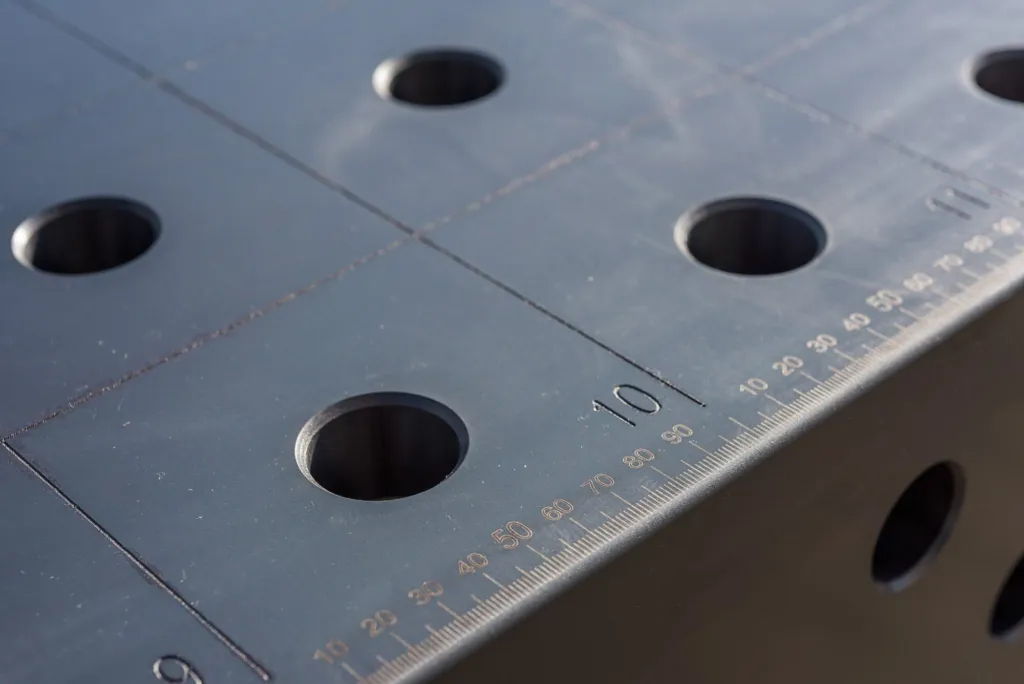
A hole grid for system accessories needs holes with an exact diameter, even spacing and a vertical axis; otherwise bolts jam or stops sit at an angle. On a table of 2000 x 1000 mm with a 100 mm grid, that means around 200 holes in the plate, plus the holes in the side walls.
If you have access to a CNC machining centre of a suitable size, you can also have the hole pattern made as subcontract work. That is usually more accurate than drilling in your own workshop.
For a load-bearing fixture table you need a thick structural steel plate, side walls, reinforcements and a sturdy frame, quickly adding up to several hundred kilograms of steel. A plate of 2000 x 1000 x 25 mm alone weighs around 392 kg. How to calculate such weights is shown in the guide Size and plate thickness.
Structural steel of grade S355 is widespread. At die schmiede, the PRO tables are made of S355J2+N and the Standard tables of the micro-alloyed fine-grain steel S355MC. An untreated plate rusts faster, and spatter sticks more firmly. Heat treatment shops offer plasma nitriding as subcontract work, provided the plate fits into the furnace. Drilling and machining come first, because any later machining removes the hardened surface layer at that point again.
System accessories such as quick-release clamping bolts, stops and clamps only work if hole diameter, plate thickness and grid pitch match the accessories. Quick-release clamping bolts have a fixed clamping range designed for particular plate thicknesses. In System 28, 15 mm and 25 mm are widespread, and die schmiede offers bolts and accessory sets for exactly these two thicknesses.
So plan a self-built table starting from the accessories: choose the system first, then define plate thickness and grid. A 20 mm plate looks like a good compromise on paper, but it can mean that standard bolts do not clamp securely. Which system suits your work is explained in System 16 or System 28.
If you want to build yourself but need an accurate hole grid, you can buy the drilled table top and make the frame yourself. That leaves the demanding work, meaning flatness, hole pattern and surface, with the manufacturer, while you adapt height, shelves or castors to your workshop.
On request, die schmiede makes tables without feet and with individual table legs. Individual height-adjustable table feet in 80 x 80 x 6 mm hollow section are also available for construction bridges and welding tables, according to the shop for a working range of approx. 860 to 980 mm. You will find them under Extensions.
A bought fixture table is usually the better choice if you need repeatable accuracy, want to use system accessories or can put the time for building to productive use.
The criteria for buying are summed up in the buying guide. For general workshop tasks, the Standard welding table with 15 mm is suitable, for heavy work the PRO welding table with 25 mm.
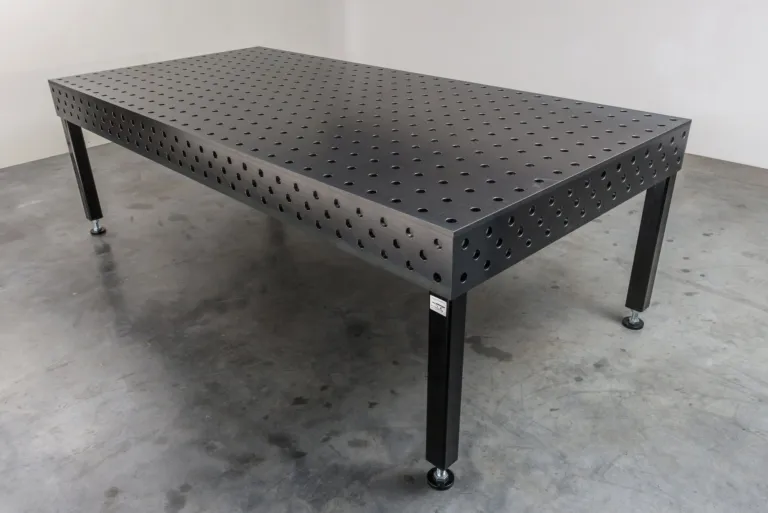
Plasma nitrided, drilled in a 100 mm grid and with matching accessories: welding tables from die schmiede in Marktsteft, Germany. Ask for a table without feet if you want to build the frame yourself. The online shop is in German and delivers within Germany only; for other countries, request a quote.
The thicker the plate, the stiffer it is and the less it distorts when side walls and frame are welded on. For a simple table without a hole grid, the thickness depends on your workpieces and the material available. If the table is to take system accessories, choose a thickness for which clamping bolts exist, in System 28 usually 15 or 25 mm.
As preparatory work yes, as finished holes usually not. Plasma-cut holes are often slightly tapered, have a rough, hardened cut edge and deviate in diameter. Quick-release clamping bolts, on the other hand, need a cylindrical, accurate hole. If you pre-cut holes thermally, bring them to final size with an annular cutter or on a drilling machine and chamfer them.
Distortion cannot be prevented completely, but it can be reduced considerably. Tack symmetrically, weld short seams alternately and let the work cool down in between. Fix the plate on a flat base and bolt the frame where possible. A thick plate distorts less than a thin one. Check flatness with a straightedge and feeler gauge.
You should not use galvanised steel for the work surface. During welding and heating the zinc vaporises, and the fumes are harmful to health and can cause metal fume fever. Zinc near the seam also promotes porosity. For frame parts outside the welding area, galvanised material is less critical, but the work surface should be bare steel.
In terms of material, a DIY build is often cheaper, but not necessarily in the overall calculation. Besides the plate, there are sections, drilling tools, possibly subcontract work for drilling, surface machining and nitriding, and many hours of your own working time. Add these items up honestly and compare them with current prices for finished tables. For a simple table without a hole grid, the calculation is more likely to work out.
When buying a welding table, plate thickness, format and hole system matter most, followed by surface, weight, working …
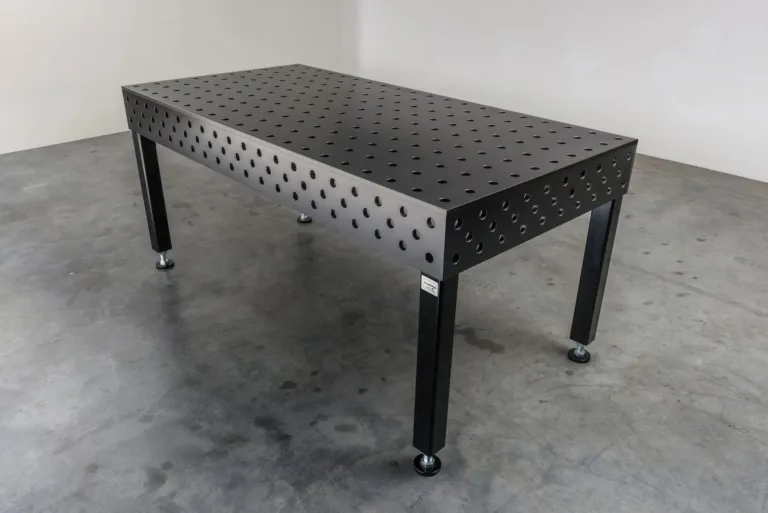
The Standard steel welding table has a 15 mm plasma nitrided welding table top in micro-alloyed fine-grain steel …
The right welding table size follows from your typical workpiece plus room for clamping tools, and the right …
5.012 reviews on Google
Ich kam mit einem kleinen außergewöhnlichen Anliegen und freue mich über so viel spontane Hilfe, Freundlichkeit und Professionalität, DANKE!
Tanja B.View on Google: review by Tanja B. (opens in a new tab)
Nicht mehr daran geglaubt - aber es gibt sie noch ! Deutsche Wertarbeit !! Rechtzeitig zum Frühlingsanfang konnten wir unsere "Wasserdichte Balkonanlage" mit Außentreppe einweihen und sind vollends begeistert von der…
Hubert L.View on Google: review by Hubert L. (opens in a new tab)
Eine Super-Schmiede, die auch Außergewöhnliche Produkte kreieren kann. Meine Kreuz, die ich zur Entstörung von Elektrosmog wurden auf Millimeter genaue Einstellung geschmiedet. Das war eine Klasseleistung! Jetzt kann ich wieder…
GoggoschelleView on Google: review by Goggoschelle (opens in a new tab)
Unsere verbogene Garagentorstange wurde sehr kurzfristig gerade gerichtet. Nettes Team. Gerne wieder.
knecht116View on Google: review by knecht116 (opens in a new tab)
Sehr kompetente Beratung ohne etwas verkaufen zu wollen! In Zukunft erste Anlaufstelle!
Wir haben im Januar einen Balkon mit Geländer und Treppe zum Garten erhalten und sind mit der Arbeit von "Die Schmiede" vollstens zufrieden. Die gesamte Abwicklung von Planung bis Montage hat problemlos geklappt. Wir können Herrn…
Daniela L.View on Google: review by Daniela L. (opens in a new tab)
Top Firma, zuverlässig, fair, preiswert, spitze Arbeit… immer wieder gerne!
Dieter H.View on Google: review by Dieter H. (opens in a new tab)
Wann immer ich Hilfe bei der Reparatur von Gartendekorationen aus Metall benötigte, wandte ich mich immer an die Schmiede. Warum? denn die Mitarbeiter sind sehr hilfsbereit und immer hilfsbereit bei Metallarbeiten. Hier sind Sie…
Super freundlich und die Schweißtische haben eine Top Qualität. Weiter so !
Michael M.View on Google: review by Michael M. (opens in a new tab)
Super höfliche Fachkräfte die tolle Arbeit geleistet haben in kurzer Zeit. Der Chef war vor Arbeitsbeginn persönlich vor Ort und jederzeit erreichbar! Qualität zu einem defitnitv fairen Preis. Top Firma! Wir sind mit unserem Zaun…
Damla K.View on Google: review by Damla K. (opens in a new tab)
Wir haben vor einem Jahr ein neues Balkongeländer von "Die Schmiede" erhalten. Alles war super, der Chef persönlich hat Maß genommen und nach nur 4 Wochen erfolgte direkt die Montage. Das alles zu einem Super Preis und man hat…
Philipp B.View on Google: review by Philipp B. (opens in a new tab)
Reviews are shown in their original language (German). This is a selection of the most recent Google reviews with 4 or 5 stars and a written comment (up to 12). Reviews have not been checked for authenticity.