
System 16 or System 28
A 28 mm or 16 mm welding table differs in the diameter of its holes and therefore in …
Guide: buying advice
When buying a welding table, plate thickness, format and hole system matter most, followed by surface, weight, working height and accessories. This checklist takes you through the decision in ten points.
Last updated
In short: The right welding table fits your workpieces, your accessories and your workshop. What counts is plate thickness, format, hole system, a wear-resistant surface, weight and location, working height and an expandable accessory system. Before you order, also clarify freight delivery and who will help you with questions.
These ten points decide whether a welding table will suit your work for years. Go through them in order before you settle on a model.
Plate thickness determines how stiff a welding table is, how much it weighs and which clamping bolts fit. In System 28, plates of 15 mm and 25 mm are widespread. A 15 mm plate is lighter and is sufficient for many jobs in fabrication, metalwork and maintenance. A 25 mm plate deflects less under heavy components and copes better with point loads.
die schmiede builds both versions: the Standard welding table with 15 mm and the PRO welding table with 25 mm, whose top is additionally surface ground. A detailed comparison with all weights is in the guide Size and plate thickness.
The right format depends on your typical workpieces plus room for stops and clamps around the part. If you choose the format based on the largest single part, which rarely comes up, you often end up with a table that is too large and too heavy for everyday work. For occasional extra lengths there are extension arms, construction bridges or a second table.
The formats from die schmiede range from 1000 x 1000 mm to 2900 x 1400 mm in the Standard line and up to 3000 x 1500 mm in the PRO line. Larger and non-standard sizes are made to order on request, see Large and custom sizes. How to derive the format from your workpieces is shown in the guide Size and plate thickness.
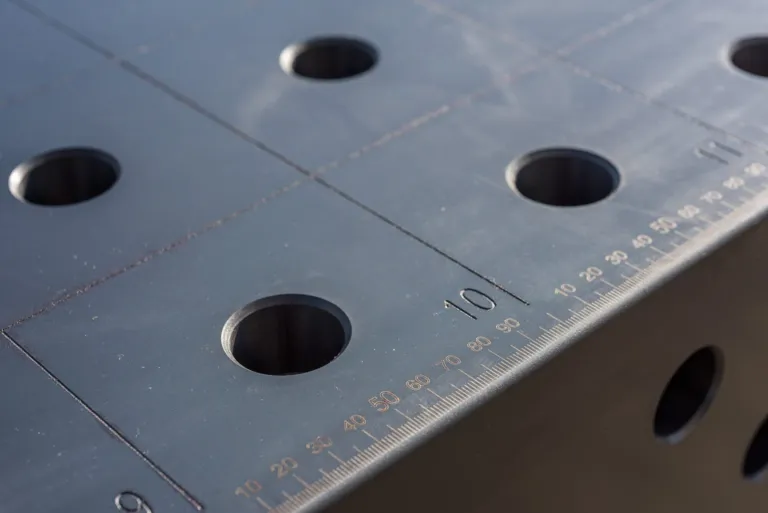
The hole system determines which accessories you can use, and it cannot be changed after purchase. System 16 with 16 mm holes and System 28 with 28 mm holes are widespread. System 28 is designed for heavy components and high clamping forces, System 16 for lighter parts and a finer grid. If you already own clamping tools, their system is usually the strongest argument.
All welding tables from die schmiede use System 28, with a grid of 100 x 100 mm measured from hole centre to hole centre. PRO tables are also available with diagonal holes: the offset additional holes allow even more flexible clamping and in some cases save stops and clamps. The differences between the systems are explained in System 16 or System 28.
A plasma nitrided surface is harder and more wear-resistant than untreated steel, and weld spatter adheres less firmly to it. Untreated tables rust faster, and spatter bonds more easily with the surface. A stainless steel welding table makes sense if you mainly process stainless steel and need to avoid contamination rust on your parts.
The steel tables from die schmiede are plasma nitrided; for the PRO tables the manufacturer states a surface hardness of around 850 HV. For stainless steel work there is the stainless steel welding table in 1.4301. What nitriding does in detail is covered in Plasma nitriding explained.
A welding table with a hole grid weighs from just over 200 kg to well over a tonne, depending on format and plate thickness. According to the shop, a PRO table from die schmiede in 2000 x 1000 mm weighs approx. 736 kg, without workpiece and accessories. So check in advance whether the floor can carry this load, whether it is level and whether you can reach the workpiece from at least two sides.
If the table needs to stay mobile, heavy-duty swivel castors are an option. According to the shop, the castors from die schmiede can be levelled and give a working height of 870 to 940 mm. Also plan space for the welding machine, fume extraction and a trolley for the accessories.
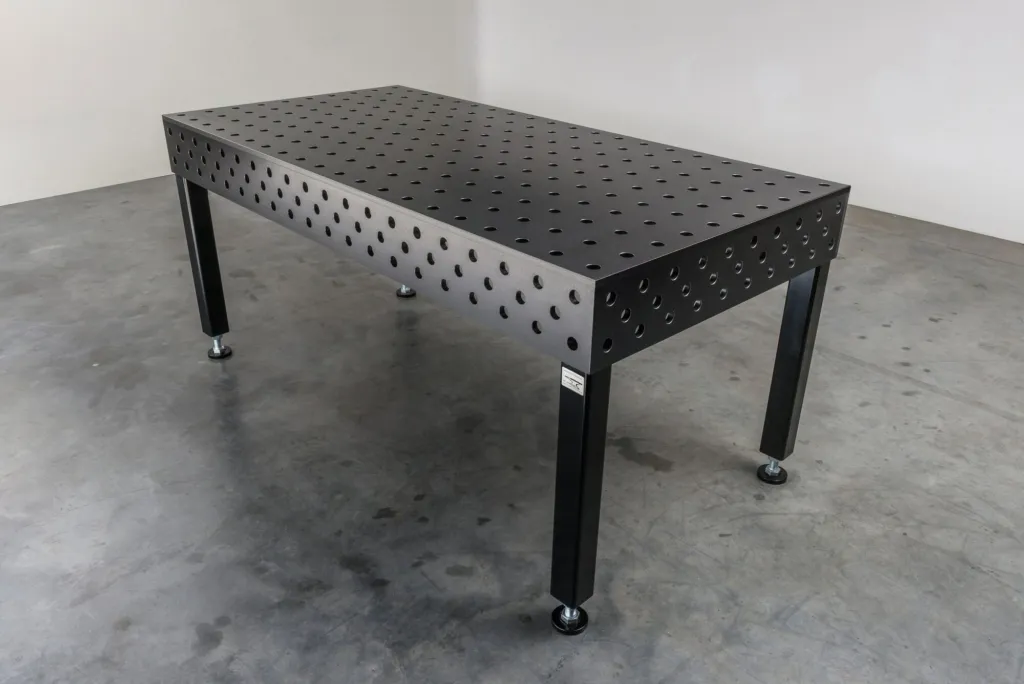
An adjustable working height matters because the actual working position is table height plus workpiece height. A flat frame and a tall assembly need different table heights. Height-adjustable feet also compensate for uneven workshop floors.
The tables from die schmiede stand on height-adjustable feet made of structural hollow section 80 x 80 x 6 mm and, according to the shop, can be set from approx. 865 to 965 mm. How to find the right height is described in the working height section of the size guide.
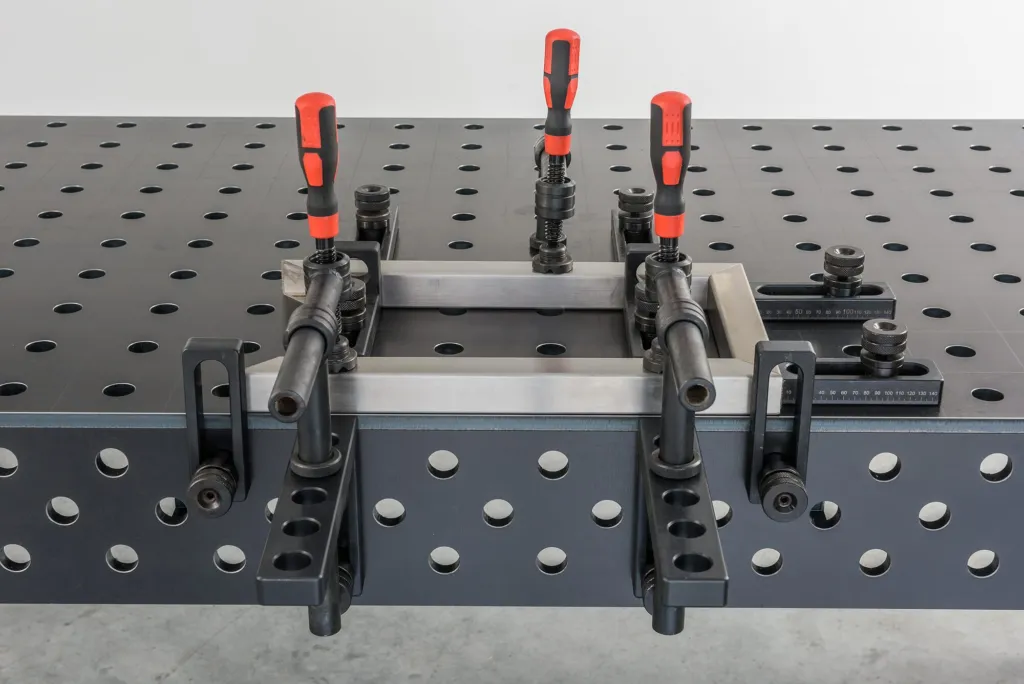
A fixture table only delivers its full benefit with clamping tools: clamping bolts, stops and clamps are the basic equipment. With them you position parts at accurate angles and fix them without measuring again every time. Start with a few pieces and add to them selectively once you know which tasks come up often.
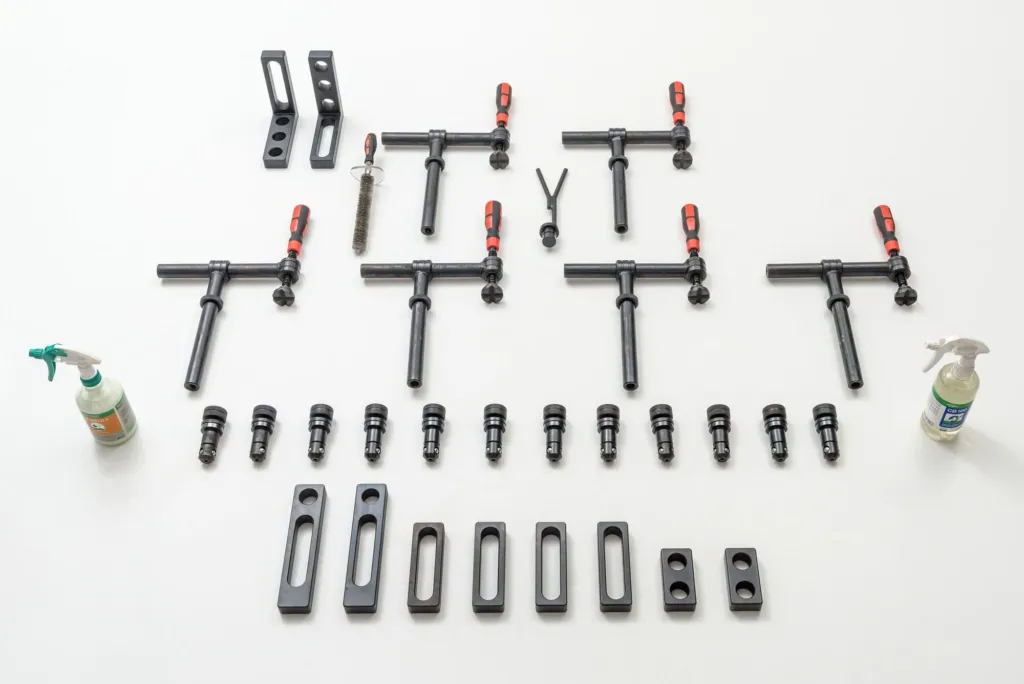
At die schmiede, the starter set contains a 90° screw clamp, a quick-release clamping bolt and a 275 L stop and clamping square. Accessory sets 1.0 to 4.0 contain 24, 32, 43 or 53 parts. Clamping bolts and sets are each available in a version for 15 mm and for 25 mm plate thickness. Contents and differences of the sets are shown on Accessory sets.
An expandable welding table has drilled side walls to which extension arms, angles and construction bridges can be attached. That way you enlarge the work surface when needed without buying a bigger table straight away. With construction bridges or connecting bolts, two tables can also be joined into one surface.
The tables from die schmiede have 200 mm high, drilled side walls. They also allow vertical constructions without additional accessories. The matching parts are listed under Extensions and construction bridges.
Because of their weight, welding tables are delivered by freight forwarder on a pallet, usually kerbside. The forwarder brings the goods to the edge of your property, and you organise the route into the workshop yourself. Measure gates, doors and paths to the final location beforehand.
At die schmiede, shipments from 200 kg go by freight forwarder. For unloading, die schmiede requires a forklift at the delivery address and agrees the delivery date with you in advance. The table arrives compact on a pallet, and you fit the feet yourself. The online shop delivers within Germany only; freight delivery to other European countries is available on request with an individual quote via the contact page.
A welding table is an investment for many years, so complete technical data and a contact person you can reach both matter. Make sure that material, plate thickness, surface treatment, side wall height and scope of delivery are clearly stated. Ask whether accessories and spare parts can be bought later and whether custom sizes are possible.
The manufacturer die schmiede GmbH is a metal fabrication business in 97342 Marktsteft, Germany, that makes welding tables with a hole grid and builds railings, gates and stairs itself. Custom sizes, individual table legs and tables without feet are available on request. Buying from the manufacturer means you discuss questions about the application or a custom size directly with the business that builds the tables. Whether a DIY welding table is worth it instead is weighed up in Build or buy.
Tell die schmiede about your typical workpieces, the format you have in mind and your country, and you will receive an individual quote. Formats, plate thicknesses and accessory sets with current prices are listed in the online shop, which is in German and delivers within Germany only.
For beginners, a fixture table with a 15 mm plate in a medium format such as 1200 x 800 mm or 1500 x 1000 mm is a good choice. It is lighter than a table with a 25 mm plate, takes up less space and can be expanded later with extension arms or a second table. What matters is choosing a system from the start for which you can buy further accessories.
Yes, a fixture table pays off as soon as you regularly weld frames, racks or similar assemblies. The visible grid shows right angles at a glance, and stops and clamps hold the parts accurately in position. That saves measuring time when tacking and reduces rework. The table shows its strengths with one-off pieces as well as with small batches.
No, to start with, a few clamping bolts, two or three stops or clamping squares and a few screw clamps are enough. With these, most frames and angle joints can be set up securely. Larger sets pay off once you know which tasks come up regularly, or when several people work at the table at the same time. Make sure the accessories match your plate thickness.
You recognise a high-quality welding table by traceable technical data: material, plate thickness, surface treatment, grid pitch, side wall height and the design of the substructure. Good signs are a machined and hardened surface, chamfered holes, a reinforced underside and stable, height-adjustable feet. If such information is missing, ask the manufacturer before you order.
No single model suits every workshop: the right welding table is the one whose plate thickness, format and hole system match your workpieces and the accessories you already own. For general workshop tasks a 15 mm plate is often enough, for heavy components and high clamping forces a 25 mm plate is stiffer. Compare each candidate against the ten points of the checklist above.
Yes, a welding table with drilled side walls can be enlarged afterwards. Extension arms lengthen the work surface, and construction bridges or connecting bolts join two tables into one large surface. When buying more, choose the same hole system and the same plate thickness, so that grid and clamping tools match and both tables can be set to the same height.
Castors make sense if you need to move the table around the workshop or between workstations. Look for sufficient load capacity per castor, brakes and levelling for uneven floors. For heavy tables and work involving high forces, standing firmly on feet is usually the more stable solution, because the table cannot then shift.
Typical mistakes are a format that is too small to leave room for clamping tools, a hole system that does not match your existing accessories, and an underestimated weight for unloading and installation. Accessories should also be planned from the start, because only with them does a fixture table show its advantages. Go through the checklist above point by point.
A 28 mm or 16 mm welding table differs in the diameter of its holes and therefore in …
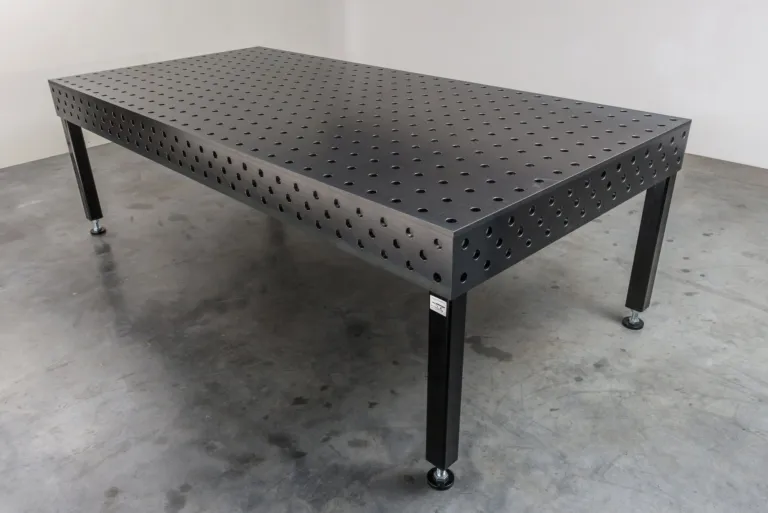
The right welding table size follows from your typical workpiece plus room for clamping tools, and the right …
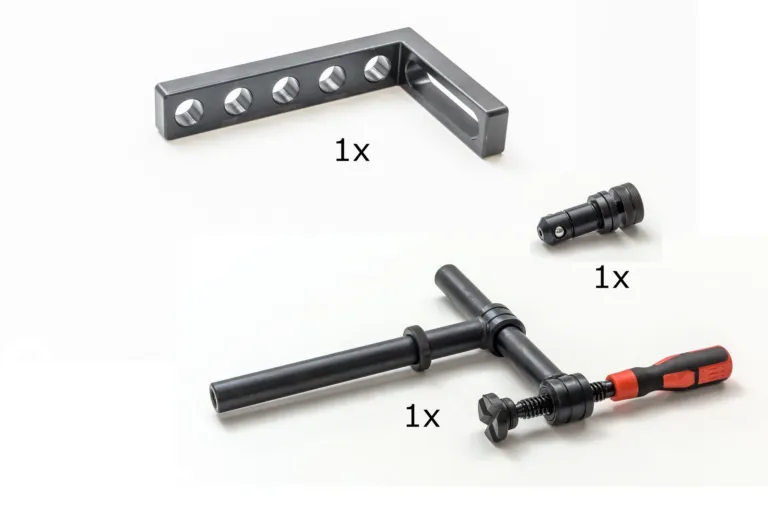
Five welding table accessory sets are available from die schmiede for the System 28 hole grid: the starter …
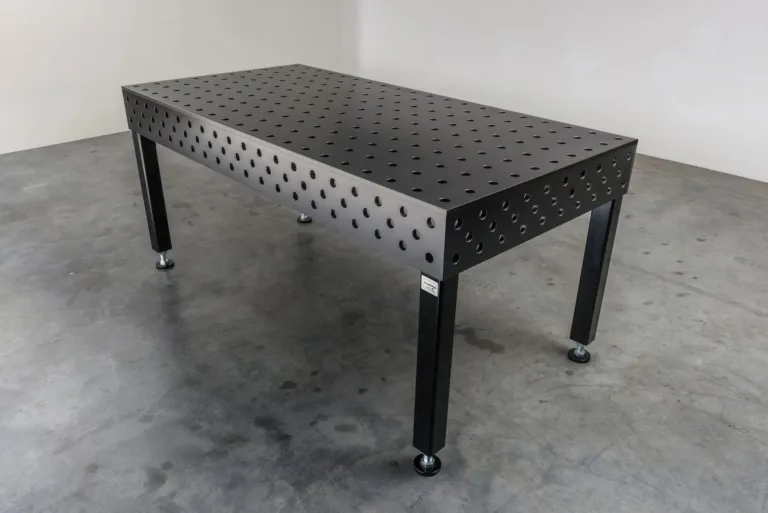
The Standard steel welding table has a 15 mm plasma nitrided welding table top in micro-alloyed fine-grain steel …
5.012 reviews on Google
Ich kam mit einem kleinen außergewöhnlichen Anliegen und freue mich über so viel spontane Hilfe, Freundlichkeit und Professionalität, DANKE!
Tanja B.View on Google: review by Tanja B. (opens in a new tab)
Nicht mehr daran geglaubt - aber es gibt sie noch ! Deutsche Wertarbeit !! Rechtzeitig zum Frühlingsanfang konnten wir unsere "Wasserdichte Balkonanlage" mit Außentreppe einweihen und sind vollends begeistert von der…
Hubert L.View on Google: review by Hubert L. (opens in a new tab)
Eine Super-Schmiede, die auch Außergewöhnliche Produkte kreieren kann. Meine Kreuz, die ich zur Entstörung von Elektrosmog wurden auf Millimeter genaue Einstellung geschmiedet. Das war eine Klasseleistung! Jetzt kann ich wieder…
GoggoschelleView on Google: review by Goggoschelle (opens in a new tab)
Unsere verbogene Garagentorstange wurde sehr kurzfristig gerade gerichtet. Nettes Team. Gerne wieder.
knecht116View on Google: review by knecht116 (opens in a new tab)
Sehr kompetente Beratung ohne etwas verkaufen zu wollen! In Zukunft erste Anlaufstelle!
Wir haben im Januar einen Balkon mit Geländer und Treppe zum Garten erhalten und sind mit der Arbeit von "Die Schmiede" vollstens zufrieden. Die gesamte Abwicklung von Planung bis Montage hat problemlos geklappt. Wir können Herrn…
Daniela L.View on Google: review by Daniela L. (opens in a new tab)
Top Firma, zuverlässig, fair, preiswert, spitze Arbeit… immer wieder gerne!
Dieter H.View on Google: review by Dieter H. (opens in a new tab)
Wann immer ich Hilfe bei der Reparatur von Gartendekorationen aus Metall benötigte, wandte ich mich immer an die Schmiede. Warum? denn die Mitarbeiter sind sehr hilfsbereit und immer hilfsbereit bei Metallarbeiten. Hier sind Sie…
Super freundlich und die Schweißtische haben eine Top Qualität. Weiter so !
Michael M.View on Google: review by Michael M. (opens in a new tab)
Super höfliche Fachkräfte die tolle Arbeit geleistet haben in kurzer Zeit. Der Chef war vor Arbeitsbeginn persönlich vor Ort und jederzeit erreichbar! Qualität zu einem defitnitv fairen Preis. Top Firma! Wir sind mit unserem Zaun…
Damla K.View on Google: review by Damla K. (opens in a new tab)
Wir haben vor einem Jahr ein neues Balkongeländer von "Die Schmiede" erhalten. Alles war super, der Chef persönlich hat Maß genommen und nach nur 4 Wochen erfolgte direkt die Montage. Das alles zu einem Super Preis und man hat…
Philipp B.View on Google: review by Philipp B. (opens in a new tab)
Reviews are shown in their original language (German). This is a selection of the most recent Google reviews with 4 or 5 stars and a written comment (up to 12). Reviews have not been checked for authenticity.